Menu Website

- Home
- MediaOutReach
- CPA Australia outlines recommendations for Hong Kong's First Five-Year Plan and 2026 Policy Address

CPA Australia outlines recommendations for Hong Kong's First Five-Year Plan and 2026 Policy Address
Kamis, 13 Agustus 2026 | 13:48
Link berita berhasil disalin!
HONG KONG SAR -
Media OutReach Newswire - 13 August 2026 - CPA Australia has suggested the HKSAR Government to use Hong Kong's
First Five-Year Plan (2026-2030) and the
2026 Policy Address
to strengthen the city's long-term competitiveness, accelerate
innovation, deepen capital formation and support the transition to a
more sustainable and resilient economy.
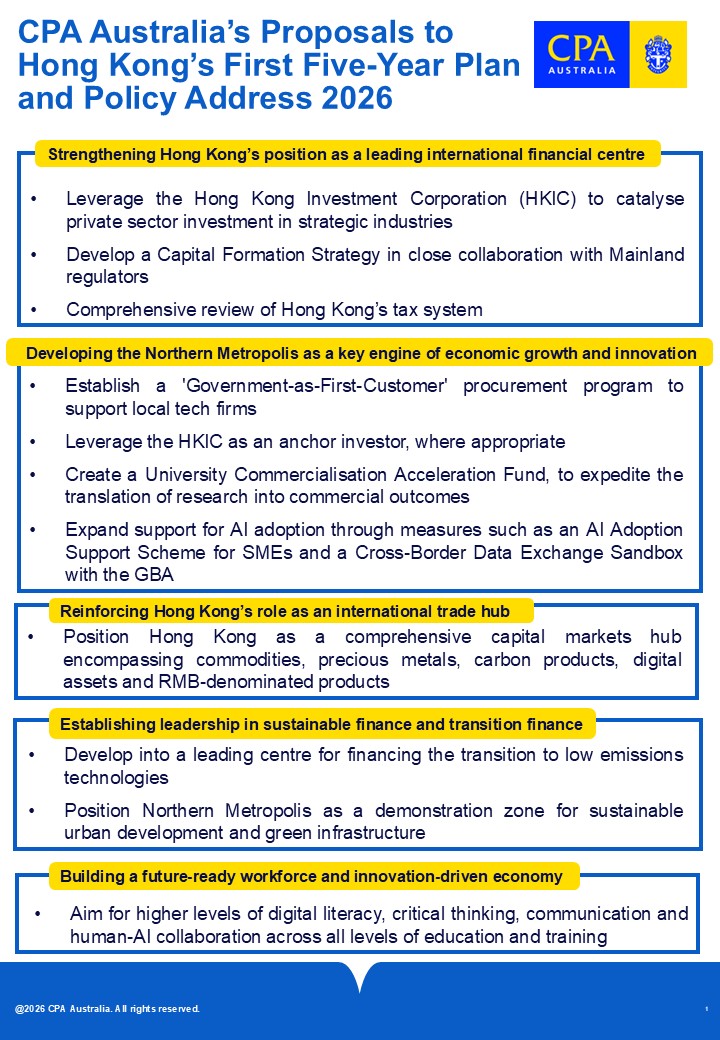
As one of the world's largest professional accounting bodies, CPA Australia has today submitted to the government a comprehensive series of policy recommendations under the following themes:
Macro vision and strategic positioning
Mr Cyrus Cheung, President of CPA Australia Greater China Division, emphasised the importance of long-term planning to support Hong Kong's future competitiveness; "Hong Kong is entering an important period of economic development. The formulation of Hong Kong's first Five-Year Plan alongside China's 15th Five-Year Plan and the 2026 Policy Address provides an opportunity to leverage the city's unique strengths, support innovation and sustainable investment, and strengthen its long-term competitiveness."
Mr Cheung said Hong Kong should build on its role as a "super-connector" and "super-value-adder" by broadening its strategic focus beyond traditional trade and financial flows. "We recommend positioning Hong Kong as a comprehensive capital markets hub encompassing commodities, precious metals, carbon products, digital assets and RMB-denominated products. Given its strong financial, regulatory and legal foundations, Hong Kong should set a long-term ambition to become Asia's leading centre for gold trading, clearing, settlement, financing and risk management."
He added that Hong Kong is well placed to play a larger role in supporting the international expansion of Chinese enterprises.
CPA Australia's recent research on Chinese enterprises going global found that over 3,000 A-share listed companies generated RMB 4.90 trillion in overseas revenue in the first half of 2025 alone. As Chinese enterprises continue to expand into ASEAN, the Middle East, Africa and other international markets, Hong Kong should position itself as the leading provider of professional services to support their global growth.
Enhancing Hong Kong's capital market ecosystem
Mr Kelvin Leung, Deputy President of CPA Australia's Greater China Division, highlighted key priorities for enhancing Hong Kong's capital market ecosystem; "Hong Kong's long-term success will depend on its ability to evolve beyond a traditional IPO fundraising centre into a comprehensive capital formation centre, positioning the city's financial sector at the heart of international capital flows between entrepreneurs, investors, institutions and global markets."
Mr Leung said this evolution should be supported by the continued development of areas such as digital finance, asset tokenisation, offshore RMB business, wealth management and family offices. "To support Hong Kong's long-term development, the government should leverage the Hong Kong Investment Corporation (HKIC) to catalyse private sector investment in strategic industries. To further strengthen the economy, we encourage the government to develop a Capital Formation Strategy in close collaboration with Mainland regulators."
Mr Leung added that maintaining Hong Kong's tax competitiveness will be critical to preserving its status as a leading international financial centre. "We suggest a comprehensive review of Hong Kong's tax system, potentially structured as a series of interconnected reviews covering key sectors including family offices, funds, corporate treasury centres, insurance, and private credit. Led by the Advisory Committee on Tax Policy, these reviews should focus on reducing administrative burdens, assessing substance requirements and safeguarding the city's international investment appeal."
Accelerating Northern Metropolis growth and technology commercialisation
Dr Albert Wong, a divisional councillor on CPA Australia's Greater China Division, outlined a potential roadmap to support Hong Kong's technological transformation: "The Northern Metropolis should be positioned as an internationally connected engine of growth and innovation, serving as a strategic platform bringing together world-class universities, research institutions, multinational corporations, investors and technology enterprises to accelerate the development and commercialisation of new technologies."
Dr Wong said stronger support is needed to help innovative ideas move more efficiently from research laboratories to commercial markets. "To strengthen Hong Kong's innovation ecosystem, we recommend establishing a 'Government-as-First-Customer' procurement program to support local tech firms. We also recommend leveraging the HKIC as an anchor investor, where appropriate, to help attract private capital into locally developed technologies, alongside the creation of a University Commercialisation Acceleration Fund, to expedite the translation of research into commercial outcomes."
He added that Hong Kong should further strengthen support for business adoption of artificial intelligence (AI) and digital technologies. "To align with the national 'AI+' initiative and enhance business competitiveness, Hong Kong should expand support for AI adoption through measures such as an AI Adoption Support Scheme for SMEs and a Cross-Border Data Exchange Sandbox with the GBA.
Dr Wong emphasised that realising the full benefits of AI requires significant investment in education, workforce development and talent attraction. "Capturing the opportunities presented by AI requires a fundamental transformation in education and workforce skills. Hong Kong should aim for higher levels of digital literacy, critical thinking, communication and human-AI collaboration across all levels of education and training,"
Leadership in sustainable and transition finance
Highlighting long-term economic resilience and sustainable growth, Mr Cyrus Cheung added that said Hong Kong is well positioned to play a leading role in financing Asia's transition to a lower-carbon economy. "Building on its strengths as a leading centre of finance and professional services, Hong Kong is uniquely positioned to become Asia's leading centre for financing the transition to low emissions technologies and serve as a bridge between the Chinese Mainland's carbon markets and international investors. The Five-Year Plan should include a clear ambition to develop a comprehensive ecosystem for sustainable finance, transition finance, carbon trading, climate-related reporting, assurance and advisory services."
Mr Cheung said Hong Kong has a unique opportunity to leverage its access to both Mainland and international capital to support the region's decarbonisation efforts. "By adopting international sustainability standards and leveraging its access to Mainland and global capital, Hong Kong can play a leading role in mobilising investment for Asia's decarbonisation transition. The Northern Metropolis should also be positioned as a demonstration zone for sustainable urban development and green infrastructure."
CPA Australia believes that aligning near-term policy initiatives with a clear five-year strategic framework will help Hong Kong strengthen its competitiveness and accelerate its development into a more diversified, innovative and resilient economy.
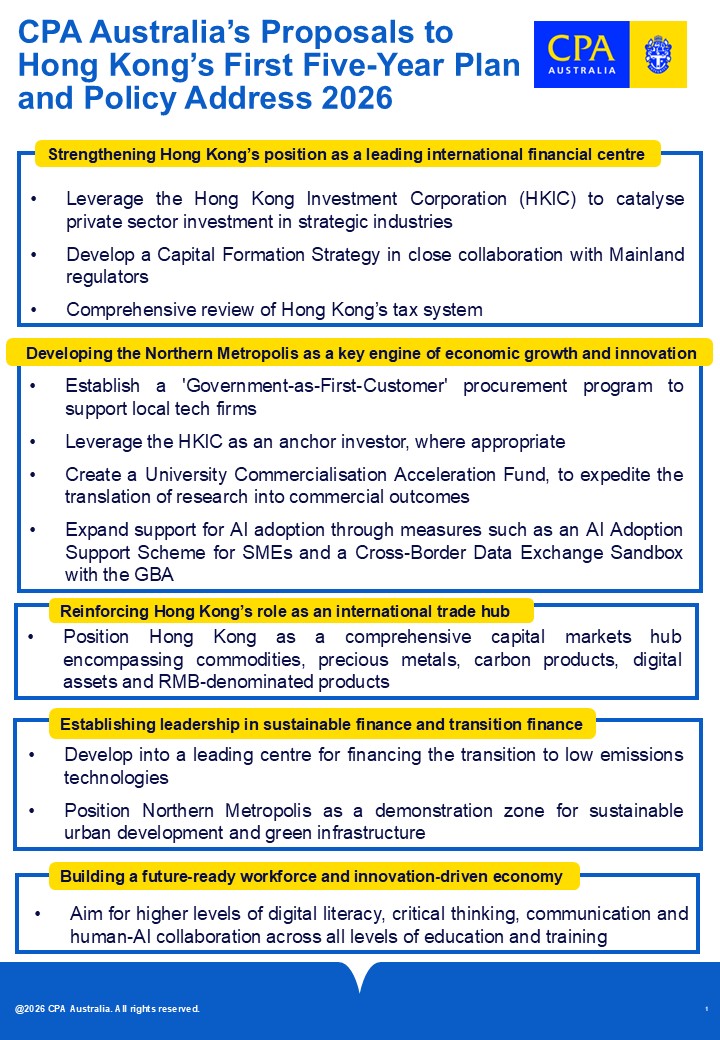
As one of the world's largest professional accounting bodies, CPA Australia has today submitted to the government a comprehensive series of policy recommendations under the following themes:
- Strengthening Hong Kong's position as a leading international financial centre
- Developing the Northern Metropolis as a key engine of economic growth and innovation
- Reinforcing Hong Kong's role as an international trade hub
- Establishing leadership in sustainable finance and transition finance
- Building a future-ready workforce and innovation-driven economy
Macro vision and strategic positioning
Mr Cyrus Cheung, President of CPA Australia Greater China Division, emphasised the importance of long-term planning to support Hong Kong's future competitiveness; "Hong Kong is entering an important period of economic development. The formulation of Hong Kong's first Five-Year Plan alongside China's 15th Five-Year Plan and the 2026 Policy Address provides an opportunity to leverage the city's unique strengths, support innovation and sustainable investment, and strengthen its long-term competitiveness."
Mr Cheung said Hong Kong should build on its role as a "super-connector" and "super-value-adder" by broadening its strategic focus beyond traditional trade and financial flows. "We recommend positioning Hong Kong as a comprehensive capital markets hub encompassing commodities, precious metals, carbon products, digital assets and RMB-denominated products. Given its strong financial, regulatory and legal foundations, Hong Kong should set a long-term ambition to become Asia's leading centre for gold trading, clearing, settlement, financing and risk management."
He added that Hong Kong is well placed to play a larger role in supporting the international expansion of Chinese enterprises.
CPA Australia's recent research on Chinese enterprises going global found that over 3,000 A-share listed companies generated RMB 4.90 trillion in overseas revenue in the first half of 2025 alone. As Chinese enterprises continue to expand into ASEAN, the Middle East, Africa and other international markets, Hong Kong should position itself as the leading provider of professional services to support their global growth.
Enhancing Hong Kong's capital market ecosystem
Mr Kelvin Leung, Deputy President of CPA Australia's Greater China Division, highlighted key priorities for enhancing Hong Kong's capital market ecosystem; "Hong Kong's long-term success will depend on its ability to evolve beyond a traditional IPO fundraising centre into a comprehensive capital formation centre, positioning the city's financial sector at the heart of international capital flows between entrepreneurs, investors, institutions and global markets."
Mr Leung said this evolution should be supported by the continued development of areas such as digital finance, asset tokenisation, offshore RMB business, wealth management and family offices. "To support Hong Kong's long-term development, the government should leverage the Hong Kong Investment Corporation (HKIC) to catalyse private sector investment in strategic industries. To further strengthen the economy, we encourage the government to develop a Capital Formation Strategy in close collaboration with Mainland regulators."
Mr Leung added that maintaining Hong Kong's tax competitiveness will be critical to preserving its status as a leading international financial centre. "We suggest a comprehensive review of Hong Kong's tax system, potentially structured as a series of interconnected reviews covering key sectors including family offices, funds, corporate treasury centres, insurance, and private credit. Led by the Advisory Committee on Tax Policy, these reviews should focus on reducing administrative burdens, assessing substance requirements and safeguarding the city's international investment appeal."
Accelerating Northern Metropolis growth and technology commercialisation
Dr Albert Wong, a divisional councillor on CPA Australia's Greater China Division, outlined a potential roadmap to support Hong Kong's technological transformation: "The Northern Metropolis should be positioned as an internationally connected engine of growth and innovation, serving as a strategic platform bringing together world-class universities, research institutions, multinational corporations, investors and technology enterprises to accelerate the development and commercialisation of new technologies."
Dr Wong said stronger support is needed to help innovative ideas move more efficiently from research laboratories to commercial markets. "To strengthen Hong Kong's innovation ecosystem, we recommend establishing a 'Government-as-First-Customer' procurement program to support local tech firms. We also recommend leveraging the HKIC as an anchor investor, where appropriate, to help attract private capital into locally developed technologies, alongside the creation of a University Commercialisation Acceleration Fund, to expedite the translation of research into commercial outcomes."
He added that Hong Kong should further strengthen support for business adoption of artificial intelligence (AI) and digital technologies. "To align with the national 'AI+' initiative and enhance business competitiveness, Hong Kong should expand support for AI adoption through measures such as an AI Adoption Support Scheme for SMEs and a Cross-Border Data Exchange Sandbox with the GBA.
Dr Wong emphasised that realising the full benefits of AI requires significant investment in education, workforce development and talent attraction. "Capturing the opportunities presented by AI requires a fundamental transformation in education and workforce skills. Hong Kong should aim for higher levels of digital literacy, critical thinking, communication and human-AI collaboration across all levels of education and training,"
Leadership in sustainable and transition finance
Highlighting long-term economic resilience and sustainable growth, Mr Cyrus Cheung added that said Hong Kong is well positioned to play a leading role in financing Asia's transition to a lower-carbon economy. "Building on its strengths as a leading centre of finance and professional services, Hong Kong is uniquely positioned to become Asia's leading centre for financing the transition to low emissions technologies and serve as a bridge between the Chinese Mainland's carbon markets and international investors. The Five-Year Plan should include a clear ambition to develop a comprehensive ecosystem for sustainable finance, transition finance, carbon trading, climate-related reporting, assurance and advisory services."
Mr Cheung said Hong Kong has a unique opportunity to leverage its access to both Mainland and international capital to support the region's decarbonisation efforts. "By adopting international sustainability standards and leveraging its access to Mainland and global capital, Hong Kong can play a leading role in mobilising investment for Asia's decarbonisation transition. The Northern Metropolis should also be positioned as a demonstration zone for sustainable urban development and green infrastructure."
CPA Australia believes that aligning near-term policy initiatives with a clear five-year strategic framework will help Hong Kong strengthen its competitiveness and accelerate its development into a more diversified, innovative and resilient economy.
📢 Publisir Berita & Kegiatan Instansi Anda di RiauGreen
Jangkau pembaca luas & terindeks Google News. Pilih paket rilis pers, advertorial, atau kemitraan media.
BERITA LAINNYA
Kamis, 13 Agustus 2026 | 14:44
Kamis, 13 Agustus 2026 | 13:48

Kamis, 13 Agustus 2026 | 11:52

Kamis, 13 Agustus 2026 | 11:52

Kamis, 13 Agustus 2026 | 11:51
Kamis, 13 Agustus 2026 | 11:50

Kamis, 13 Agustus 2026 | 11:49

Kamis, 13 Agustus 2026 | 11:49
Kamis, 13 Agustus 2026 | 11:48
BERIKAN KOMENTAR

-
-
 Kamis, 13 Agustus 2026 | 14:48
Kuehne+Nagel Berinvestasi pada Stasiun Pengangkutan Kontainer (CFS) Baru di di Kamboja
-
 Kamis, 13 Agustus 2026 | 14:48
CPA Australia Paparkan Rekomendasi bagi Rencana Lima Tahun Pertama Hong Kong dan Policy Address 2026
-
-

-
 Kamis, 13 Agustus 2026 | 14:46
Presidence: Kategori Baru Hunian Ultra-Luxury yang Dirancang untuk Dinikmati dan Diwariskan Lintas Generasi

-
-
 Kamis, 06 Agustus 2026 | 16:21
Terungkap Teka-teki Pengendara Motor yang Lewati Jalan Tol Pekanbaru Dumai
-

-
-
-
 Sabtu, 08 Agustus 2026 | 22:05
Dari Perbaikan Jalan Nasional Hingga Alokasi Hibah, Pemko Dumai Tunjukkan Komitmen Bangun Kota Idaman