World Population Day: Swiss Re Life & Health CEO says the next decade will re-write the intergenerational contract
World Population Day: Swiss Re Life & Health CEO says the next decade will re-write the intergenerational contract
Kamis, 09 Juli 2026 | 21:22
By Paul Murray, CEO Life & Health Reinsurance, Swiss Re
SINGAPORE -
Media OutReach Newswire - 9 July 2026 - Op-ed by Paul Murray, CEO Life & Health Reinsurance, Swiss Re.
Ten years.
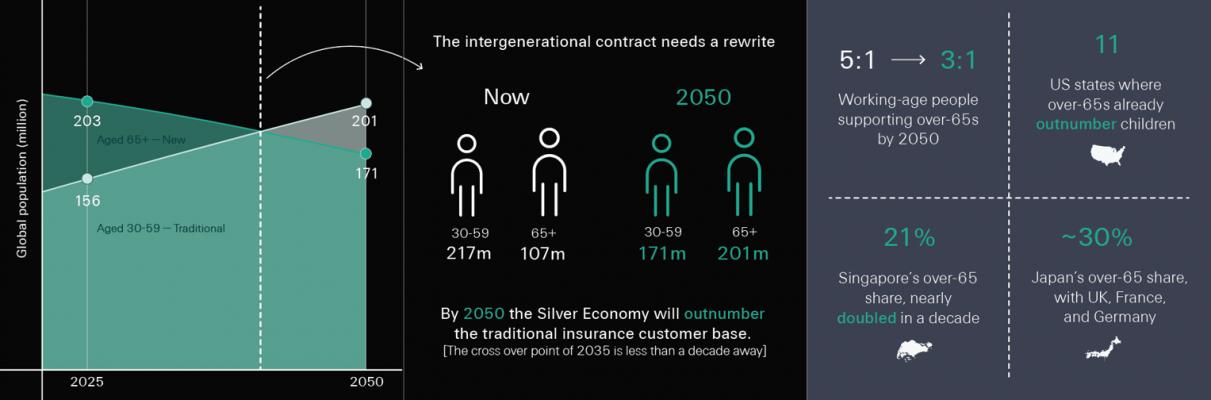
That is roughly how long we have before many societies reach one of the
most defining demographic tipping points of our era: the point at which
the "new" silver economy (over 65's) outnumber people aged 30-59 who
have traditionally been the bedrock of the life and pensions system.
The intergenerational contract needs a re-write
The significance of this shift goes far beyond demographics.
It represents a symbolic moment that forces us to rethink the
intergenerational contract: how we provide care and financial security
for people as they move into later life – and how we finance a new set
of needs.
The demographic evidence is already visible across major economies. In
the US, adults aged 65 and over already outnumber children in 11 states.
Singapore's over-65 population has nearly doubled in a decade to 21%.
Japan is approaching 30%. The UK, France and Germany are not far behind
These numbers are well-known. But their meaning is not yet fully reflected in our industry's existing product strategy.
The tipping point is also more than a statistical curiosity. We will
experience it through the decisions we make coming into retirement and
to secure the future of the generation coming after us. We will need to
make new choices on how we fund care. We will need to make new
assumptions about when to retire. And we will face a new reality around
how much of the financial burden falls on the state, families or the
individual.
Families have always carried the weight of old age, even as pensions,
healthcare systems and social care programmes have broadened that
responsibility across society.
But the arithmetic underpinning the system is breaking. Globally, the
ratio of working-age people financially supporting each person over 65
is projected to fall from around five-to-one in 2021 to three-to-one by
2050. Across developed markets, debates about pension reform, healthcare
funding and retirement ages reflect the same underlying question: how
do we maintain security and dignity later in life when there are fewer
hands to carry the weight'
It's not a crisis of demographics. It's a crisis of design – our systems
were built for shorter lives and larger workforces, and they haven't
been rebuilt for the world we are actually entering.
That insight matters because it challenges how we think about
insurance's role. I believe we have less than a decade to develop the
products that the older consumers who make up the Silver Economy – and
their families – will need.
There will be no silver bullet. We cannot return to a single solution
based around family care versus public provision. The individual retiree
will be the focus, but our thinking will need to be based on a more
collaborative model in which families, governments, communities and the
private sector work together.
Recent Swiss Re consumer research in France and Germany revealed
something striking. People don't think about later life in terms of
pensions or insurance policies. They think about practical outcomes:
staying independent, being resilient when health shocks hit, not
becoming a burden to their children.
Our industry has spent decades optimising for wealth accumulation and
income protection during working years. Ageing societies demand we apply
the same rigour to what happens after.
That does not mean the intergenerational contract has failed. It means it is evolving.
We are already seeing what that evolution looks like in practice.
- Senior health products in Asia are closing a real gap —The
median age of cancer diagnosis is 67, yet many critical illness policies
expire before retirement even begins. The result is high out-of-pocket
expenses, stressed public healthcare, and increased burden on families.
With dedicated products to cover later life illnesses, such as senior
cancer products we are effectively closing a protection gap.
- Long term care in France has had some success with private
solutions alongside public provision. With over 1.4 million people
covered by private long term care insurance, France has built a strong
risk pool that directly addresses one of the strongest concerns
expressed by consumers: not becoming a burden on the next generation.
- Deferred annuities offer a third path beyond the binary
"draw-down versus annuity" thinking. By combining flexibility today with
guaranteed income later, they help transform longevity from an
individual financial risk into one that can be shared more broadly.
At first glance these solutions appear very different. In reality, they
are pieces of the same puzzle. Each expands the circle of support around
the individual. They help families carry less of the burden alone, and
they complement the work of state safety nets.
That is what the next evolution of the intergenerational contract looks like in practice.
Ageing societies are one of humanity's great achievements. But if our
products and institutions stay built for a demographic reality that no
longer exists, achievement curdles into liability.
We have a decade to close that gap. Let's treat it as a product-development window, not a deadline.
Disclaimer
Certain statements and illustrations contained herein are
forward-looking and are made for informational purposes only. These
statements (including as to plans, objectives, targets, and trends) and
illustrations provide current expectations of future events based on
certain assumptions and include any statement that does not directly
relate to a historical fact or current fact. Readers are cautioned not
to place undue reliance on forward-looking statements. Swiss Re
undertakes no obligation to publicly revise or update any
forward-looking statements, whether as a result of new information,
future events or otherwise. Further information on forward looking
statements and the use of information contained in this publication can
be found in the Legal Notice section on Swiss Re's website.



 https://www.swissre.com/
 https://www.linkedin.com/company/swiss-re/
















 Sabtu, 04 Juli 2026 | 10:54
 Minggu, 28 Juni 2026 | 11:25
 Sabtu, 27 Juni 2026 | 11:20
 Sabtu, 04 Juli 2026 | 10:51
 Sabtu, 04 Juli 2026 | 10:52