Menu Website

- Home
- MediaOutReach
- Singapore fintech investment moderates in H1 2026 as capital concentrates in fewer, larger deals: Pulse of Fintech H1 2026

Singapore fintech investment moderates in H1 2026 as capital concentrates in fewer, larger deals: Pulse of Fintech H1 2026
Sabtu, 29 Agustus 2026 | 08:21
Link berita berhasil disalin!
SINGAPORE -
Media OutReach Newswire
- 28 August 2026 - Singapore's fintech sector drew over US$499 million
in investment across 53 deals in the first half of 2026, according to
KPMG's
Pulse of Fintech H1'2026 report. This marks a drop from the
roughly US$1.45 billion across 97 deals recorded in H1 2025. It also
represents the most subdued first half the country saw in about close to
a decade.
The moderation was uneven across the half. After a notably quiet first quarter of about US$88 million across 26 deals, activity rebounded to some US$411 million across 27 deals in the second quarter. That recovery rested almost entirely on a single US$320 million round for a cross-border payments platform in June, which alone accounted for close to two-thirds of Singapore's total fintech investment for the half.
Anton Ruddenklau, Partner, Head of Financial Services, KPMG in Singapore said: "The headline number tells only part of the story. What we are seeing in Singapore mirrors the global market - investors are being far more selective, consolidating capital behind a small number of scaled, high-conviction platforms rather than funding behaviour we saw in prior years. A single deal carrying most of the half is a signal of that concentration. However, the fundamentals that make Singapore a strategic hub for fintech - a trusted regulatory environment, deep cross-border connectivity, and strength in payments and digital assets - remain intact, and these remain the stronghold areas where capital is still flowing."
Investment clustered around three familiar verticals: payments, digital assets and cryptocurrency, and artificial intelligence and machine learning. Most investments clustered towards earlier-stage companies building tokenisation, digital-asset and AI-enabled infrastructure, pointing to a market that is still forming at the foundations even as growth-stage funding thins.
Globally, the picture ran in the opposite direction on value. Fintech investment across venture capital, private equity and M&A rose from US$72.2 billion in H2'25 to US$103.1 billion in H1'26, putting the sector on pace for its strongest annual performance in four years. Deal volume, however, remained soft at just 2,100 deals globally in H1'26 against 2,500 in H2'25, as investors concentrated capital on large transactions centred on mature fintechs with well-proven business models. Singapore's half was a local expression of that same dynamic, fewer deals, larger concentration, and a clear premium on proven models.
Figure 1: Singapore's half-year fintech deal value and volume, H1 2019 - H1 2026
Source: KPMG Pulse of Fintech, PitchBook.
Figure 2: Singapore fintech investment by vertical, H1 2026
*Deals are frequently tagged to more than one vertical
Payments remains one of Singapore's anchor verticals
Cross-border payments proved to be one of Singapore's anchor verticals, although it was largely supported by a US$320 million deal in June. That single transaction accounted for nearly all of the US$332 million recorded across the three payments deals in the half. Two of the three deals belonging to the later stage even in a tighter funding climate reflects sustained investor appetite for scaled platforms that can move money across borders while managing compliance, currency conversion and settlement - capabilities that only grow more valuable as global trade and commerce fragment.
Digital assets and cryptocurrency continue to drive deal activity
Digital assets and cryptocurrency again accounted for the largest share of Singapore's deal count, even if individual cheque sizes were relatively modest. The larger, later-stage names were built around regulated market infrastructure, including companies such as digital-asset services providers and crypto payments firms, while the seed and early-stage cohort skewed towards exchange, brokerage and cross-chain tooling platforms. With most capital concentrated at seed and early stage (15 of the 27 deals) rather than in large growth rounds, it signals continued confidence in Singapore as a base for regulated, institutional-grade digital-asset businesses, even as the sector's weight in the market rests on young companies rather than proven, scaled platforms.
AI and machine learning stays central to the fintech thesis
Artificial intelligence and machine learning was the most active vertical of the half, featuring in 18 of Singapore's 53 deals and US$365.9 million of disclosed value. The deals were split equally across early and late stage deals.
The later-stage deals clustered around applied software that embeds AI into established financial workflows, spanning cross-border payments, investment research, insurance and claims, credit-risk modelling and document processing. These are revenue-generating platforms using AI to improve productivity and margins rather than to build entirely new markets, which is why they continued to attract the larger capital even in a more selective climate, as investors are willing to pay up for proven models where AI deepens an existing commercial edge.
At seed and early stage, the profile shifts towards agentic software and infrastructure, including agentic execution platforms, agentic networks and cross-chain automation, alongside broader AI-and-crypto tooling. This could signal that investors are expecting that autonomous, AI-driven agents may become core infrastructure for how money moves and how financial decisions are executed.
2026 - Key Global highlights
The moderation was uneven across the half. After a notably quiet first quarter of about US$88 million across 26 deals, activity rebounded to some US$411 million across 27 deals in the second quarter. That recovery rested almost entirely on a single US$320 million round for a cross-border payments platform in June, which alone accounted for close to two-thirds of Singapore's total fintech investment for the half.
Anton Ruddenklau, Partner, Head of Financial Services, KPMG in Singapore said: "The headline number tells only part of the story. What we are seeing in Singapore mirrors the global market - investors are being far more selective, consolidating capital behind a small number of scaled, high-conviction platforms rather than funding behaviour we saw in prior years. A single deal carrying most of the half is a signal of that concentration. However, the fundamentals that make Singapore a strategic hub for fintech - a trusted regulatory environment, deep cross-border connectivity, and strength in payments and digital assets - remain intact, and these remain the stronghold areas where capital is still flowing."
Investment clustered around three familiar verticals: payments, digital assets and cryptocurrency, and artificial intelligence and machine learning. Most investments clustered towards earlier-stage companies building tokenisation, digital-asset and AI-enabled infrastructure, pointing to a market that is still forming at the foundations even as growth-stage funding thins.
Globally, the picture ran in the opposite direction on value. Fintech investment across venture capital, private equity and M&A rose from US$72.2 billion in H2'25 to US$103.1 billion in H1'26, putting the sector on pace for its strongest annual performance in four years. Deal volume, however, remained soft at just 2,100 deals globally in H1'26 against 2,500 in H2'25, as investors concentrated capital on large transactions centred on mature fintechs with well-proven business models. Singapore's half was a local expression of that same dynamic, fewer deals, larger concentration, and a clear premium on proven models.
Figure 1: Singapore's half-year fintech deal value and volume, H1 2019 - H1 2026
|
Period
|
Deal value (US$M)
|
No. of deals
|
|
H1 2019
|
610
|
85
|
|
H1 2020
|
578
|
100
|
|
H1 2021
|
1,234
|
170
|
|
H1 2022
|
3,540
|
234
|
|
H1 2023
|
1,609
|
126
|
|
H1 2024
|
624
|
155
|
|
H1 2025
|
1,449
|
97
|
|
H1 2026
|
499
|
53
|
Figure 2: Singapore fintech investment by vertical, H1 2026
|
Vertical
|
No. of deals
|
Disclosed deal value (US$M)
|
|
Artificial intelligence & machine learning
|
18
|
365.9
|
|
Payments
|
3
|
332.0
|
|
Cryptocurrency / blockchain
|
27
|
95.5
|
|
RegTech
|
2
|
19.1
|
|
ESG / greentech
|
1
|
14.0
|
|
InsurTech
|
4
|
12.3
|
|
WealthTech
|
1
|
-
|
|
PropTech
|
0
|
-
|
|
Cybersecurity
|
0
|
-
|
Payments remains one of Singapore's anchor verticals
Cross-border payments proved to be one of Singapore's anchor verticals, although it was largely supported by a US$320 million deal in June. That single transaction accounted for nearly all of the US$332 million recorded across the three payments deals in the half. Two of the three deals belonging to the later stage even in a tighter funding climate reflects sustained investor appetite for scaled platforms that can move money across borders while managing compliance, currency conversion and settlement - capabilities that only grow more valuable as global trade and commerce fragment.
Digital assets and cryptocurrency continue to drive deal activity
Digital assets and cryptocurrency again accounted for the largest share of Singapore's deal count, even if individual cheque sizes were relatively modest. The larger, later-stage names were built around regulated market infrastructure, including companies such as digital-asset services providers and crypto payments firms, while the seed and early-stage cohort skewed towards exchange, brokerage and cross-chain tooling platforms. With most capital concentrated at seed and early stage (15 of the 27 deals) rather than in large growth rounds, it signals continued confidence in Singapore as a base for regulated, institutional-grade digital-asset businesses, even as the sector's weight in the market rests on young companies rather than proven, scaled platforms.
AI and machine learning stays central to the fintech thesis
Artificial intelligence and machine learning was the most active vertical of the half, featuring in 18 of Singapore's 53 deals and US$365.9 million of disclosed value. The deals were split equally across early and late stage deals.
The later-stage deals clustered around applied software that embeds AI into established financial workflows, spanning cross-border payments, investment research, insurance and claims, credit-risk modelling and document processing. These are revenue-generating platforms using AI to improve productivity and margins rather than to build entirely new markets, which is why they continued to attract the larger capital even in a more selective climate, as investors are willing to pay up for proven models where AI deepens an existing commercial edge.
At seed and early stage, the profile shifts towards agentic software and infrastructure, including agentic execution platforms, agentic networks and cross-chain automation, alongside broader AI-and-crypto tooling. This could signal that investors are expecting that autonomous, AI-driven agents may become core infrastructure for how money moves and how financial decisions are executed.
2026 - Key Global highlights
- - Global fintech investment has grown considerably over the past three six-month periods, rising from $50.5 billion in H1'25 to $72.2 billion in H2'25 to $103.1 billion in H1'26.
- - Global deal volume fell from 2,500 deals in H2'25 to 2,100 in H1'26; this remains below historic norms, reflecting continued investor selectivity despite higher capital deployment.
- - The Americas attracted over 80 percent of global fintech investment in H1'26 ($86.9 billion across 1,120 deals), of which the US accounted for $80.8 billion across 933 deals.
- - Coming off a strong 2025 that saw $39.5 billion invested across 1,714 deals, the EMEA region saw $11.3 billion invested across 626 deals in H1'26 - on pace for a decade-low for both deal volume and value.
- - Fintech investment in the ASPAC region remained muted, declining from $7.1 billion across 426 deals during H2'25 to $4.6 billion across 350 deals in H1'26.
- Global fintech M&A activity strengthened, with deal value increasing from $37.2 billion across 514 deals in H2'25 to $67.9 billion across 394 deals in H1'26
- - Venture capital investment remained strong across the global fintech sector, led by the US which saw $16.8 billion in VC investment.
- - At the sector level, payments led the way, attracting $44.2 billion in H1'26: well over 2025's annual total, as a result of several large megadeals.
- - AI-focused fintechs attract $21.4 billion across VC, PE, and M&A.
📢 Publisir Berita & Kegiatan Instansi Anda di RiauGreen
Jangkau pembaca luas & terindeks Google News. Pilih paket rilis pers, advertorial, atau kemitraan media.
BERITA LAINNYA
Sabtu, 29 Agustus 2026 | 08:31
Sabtu, 29 Agustus 2026 | 08:30
Sabtu, 29 Agustus 2026 | 08:30

Sabtu, 29 Agustus 2026 | 08:28

Sabtu, 29 Agustus 2026 | 08:27

Sabtu, 29 Agustus 2026 | 08:25
Sabtu, 29 Agustus 2026 | 08:21


Sabtu, 29 Agustus 2026 | 08:19

Sabtu, 29 Agustus 2026 | 08:18

BERIKAN KOMENTAR


-
-
-
Sabtu, 29 Agustus 2026 | 08:30
International Entertainment Corporation's FY2025/26 Interim Revenue Increases by 50.6% to HK$852.5 Million
-

-
Sabtu, 29 Agustus 2026 | 08:28
Get Orders Today with Super-Charged Delivery at Shopee's 9.9 Super Shopping Day Sale
-
Sabtu, 29 Agustus 2026 | 08:27
Hizero Spells the End of the Vacuum Era With a Full Portfolio of No-Suction™ Hard-Surface Cleaners at IFA 2026

-
 Senin, 24 Agustus 2026 | 22:07
Pertamina Patra Niaga Raih Predikat Bintang 5 dan Boyong Penghargaan di Ajang ISEA 2026
-
 Selasa, 25 Agustus 2026 | 20:10
Duiba Group Announces Rapid Scaling of AI Short Drama Business and Significant AI Technology-Driven Revenue Growth
-
 Selasa, 25 Agustus 2026 | 20:09
HIS Implementasikan B50, Perkuat Komitmen Mendukung Ketahanan Energi Indonesia
-
 Selasa, 25 Agustus 2026 | 20:08
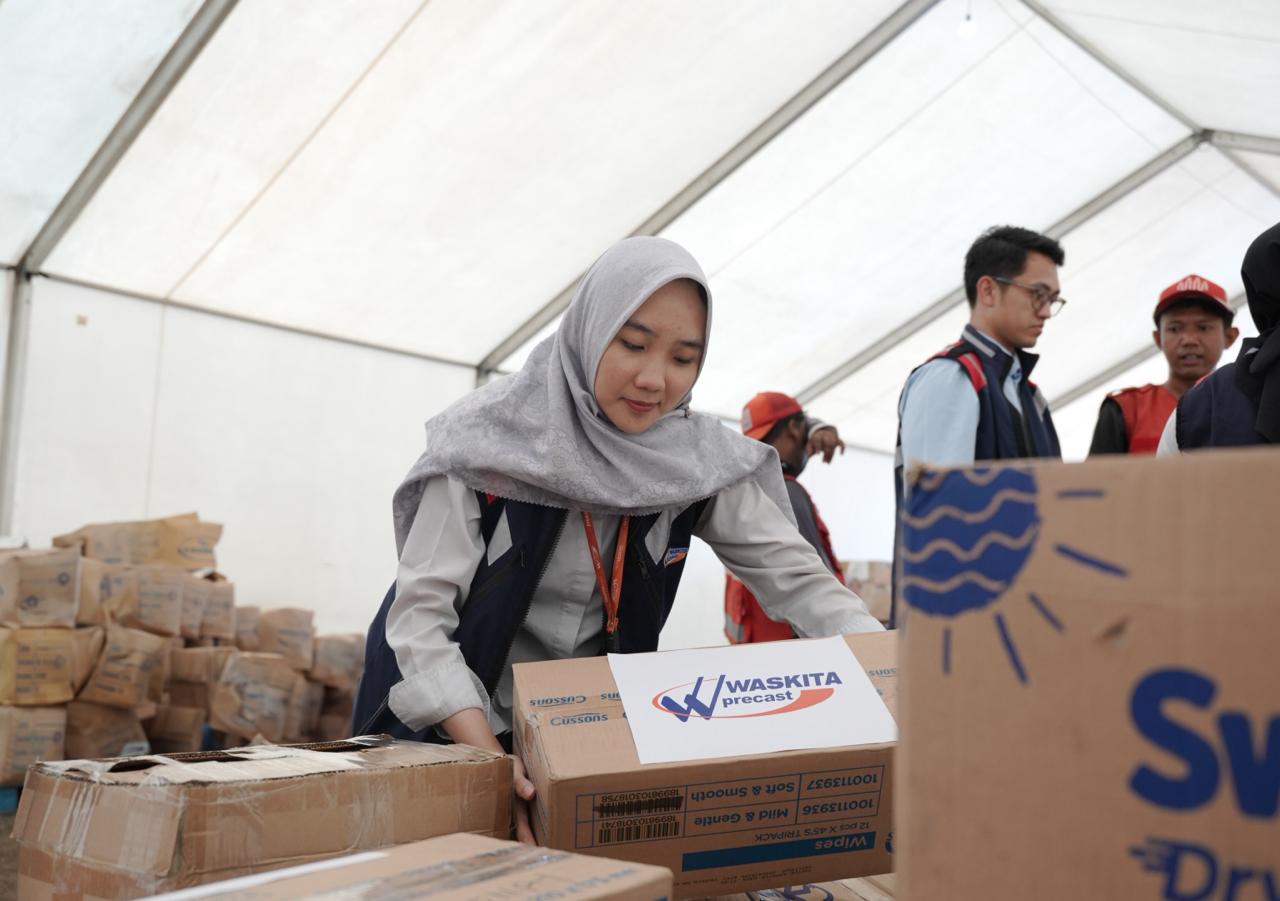
Waskita Beton Precast Bersama PMI Salurkan Bantuan Kemanusiaan untuk Masyarakat Terdampak di NTT
-