Menu Website

- Home
- MediaOutReach
- HiDream.ai Advances Its Native Omni-Modal Roadmap with HiDream-O1-World, an Interactive World Model

HiDream.ai Advances Its Native Omni-Modal Roadmap with HiDream-O1-World, an Interactive World Model
Senin, 24 Agustus 2026 | 20:59
Link berita berhasil disalin!
BEIJING, CHINA -
Media OutReach Newswire
- 24 August 2026 - HiDream.ai today launched HiDream-O1-World, a native
omni-modal interactive world model that lets users generate complete,
explorable 3D worlds from a single text prompt, image, or interactive
control.
The model combines three core capabilities - roaming, editing, and interaction - and is built on HiDream.ai's self-developed UiT (Unified Transformer) architecture. The upgraded UiT delivers a key breakthrough on two persistent challenges in the field: spatiotemporal consistency and physical consistency. As cameras pan, zoom, or track, scene geometry remains stable - objects don't vanish or deform, and collisions, occlusions, and gravitational responses follow real-world causal logic rather than appearing as randomly stitched frames.
"The value of an interactive world model isn't in generating a photorealistic 3D scene - it's in AI beginning to genuinely understand the depth of space, the texture of objects, the inertia of motion, and the logic of light and shadow," said Yao Ting, CTO of HiDream.ai. "This is a systematic reconstruction of how the physical world works. HiDream-O1-World is the first bridge in that reconstruction - every interaction leads to a world never reached before."
Topping the Leaderboard on Debut
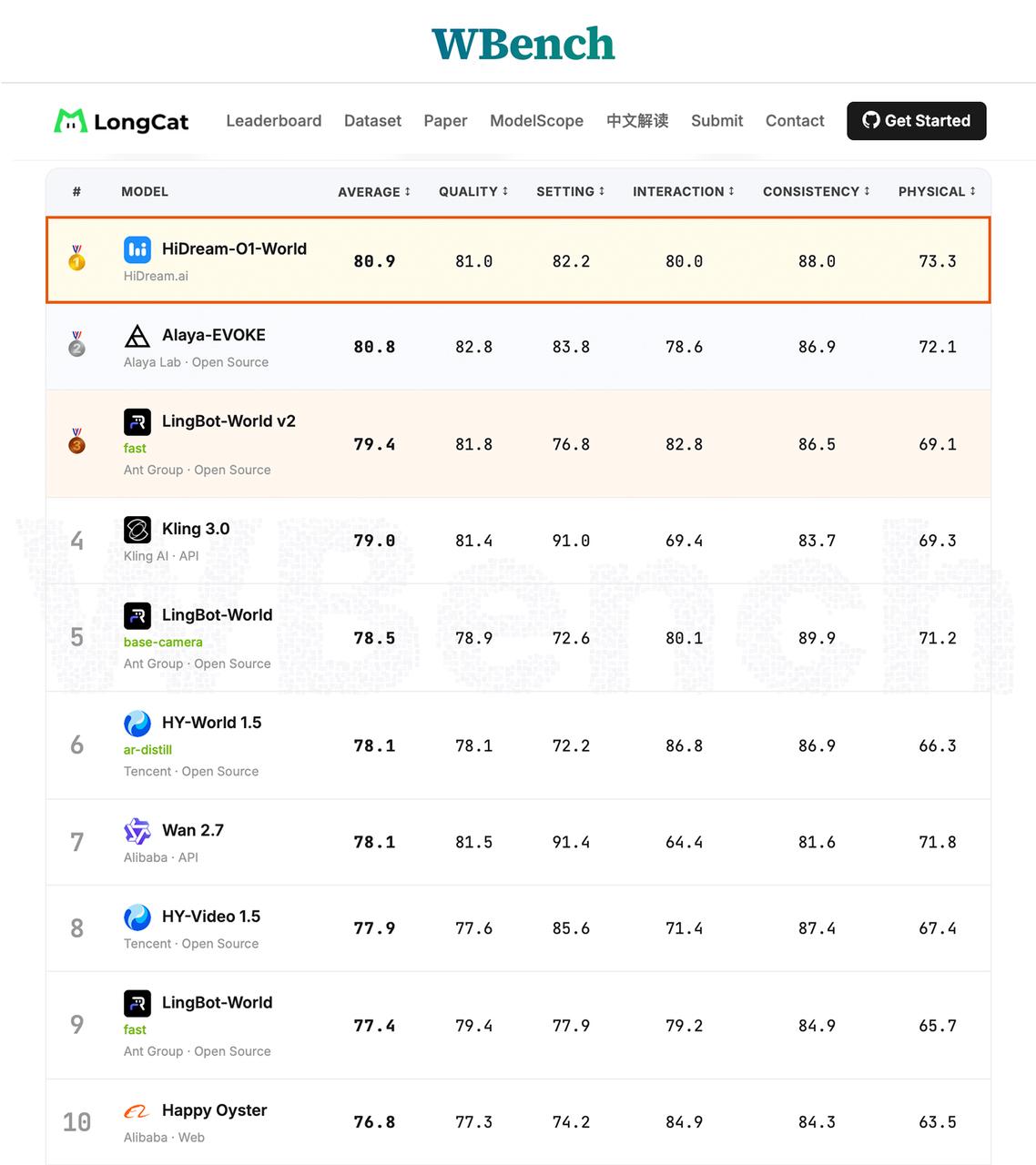
HiDream-O1-World's first third-party benchmark results came from WBench, an interactive world model evaluation benchmark jointly developed by Meituan's LongCat team and Fudan University. The model topped the core Navi sub-leaderboard with an average score of 80.9, ranked first in the Physical dimension at 73.3, and scored 88.0 on Consistency - the best overall performance on the board.
WBench covers 289 multi-turn interaction cases and 1,058 interaction turns across five dimensions and 22 metrics. Its Navi board, focused on spatial navigation and viewpoint control, is widely regarded as the core measure of a world model's spatial understanding. Topping Navi on its first entry, HiDream-O1-World sets a new performance ceiling for interactive world models - outperforming established players including Tencent Hunyuan 1.5.
One-Click World Generation for Immersive Interaction
The model lets users generate structurally complete, stylistically diverse interactive worlds from a short description, a single image, or simple controls. Upload a photo of a room, for example, and the model rapidly constructs a high-precision digital twin, completing the full panorama with accurate proportions and fine-grained detail.
Users can explore worlds in first-person or third-person mode, freely driving a character and adjusting viewpoints. In a diving scene, light patterns on the water surface and refracted glimmers on the seabed shift in sync with the camera; coral textures remain crisp and drift-free throughout.
Beyond roaming, HiDream-O1-World enables real-time editing - directing characters to grab, run, crouch, or jump, or triggering environmental events like rainfall. Changes maintain globally unified coherence across geometry, lighting, materials, and physical logic, ensuring every interaction remains self-consistent.
The model generalizes across humans, animals, and fictional characters, adapting to each one's form and motion. In a snow-climbing scene, footprints press realistic indentations into the snow, snowflakes drift at varied speeds, and distant ridgelines blend naturally with rock textures as the viewpoint shifts. It supports a wide scene and stylistic range - from real city streets and natural terrain to anime-style cartoons and AAA-game-grade rendering.
Two Core Breakthroughs: Spatiotemporal and Physical Consistency
Interactive world models have long been constrained by three problems: space, physics, and memory. Camera switches cause blurring and scene drift; physics violations undermine credibility; and without long-term memory, objects disappear when the view turns. HiDream-O1-World addresses these through two coordinated capabilities:
Long-horizon spatiotemporal consistency. The model pairs 3D priors injected into Memory context with Test-Time Training (TTT) online maintenance. The Memory mechanism encodes scene geometry and object relationships as 3D priors, letting the model "remember" explored structures across viewpoint switches - fundamentally eliminating drift and scene resets. TTT performs lightweight online adaptation during inference, dynamically optimizing adapters so internal representations stay aligned with the scene's 3D constraints. Where conventional models act like a painter redrawing every frame - with errors compounding into drift and vanishing objects - HiDream-O1-World behaves like a director with spatial memory: it records scene structure rather than re-guessing the environment at each step, recalling the corresponding view when the camera moves.
Globally stable physical consistency. On the training side, a generative world simulator produces synthetic data covering rigid-body collisions, fluid motion, soft-body deformation, and gravity-driven projectiles - systematically reinforcing the model's inductive bias through physics-simulated data. On the inference side, the same TTT mechanism enhances physical consistency online, adjusting representations when new object types or materials appear so subsequent frames better follow that scene's physics. This dual-engine design delivers gains of 13.6% over the industry average on visual-plausibility evaluation and 12.7% on causal-fidelity evaluation across fluid, collision, and deformation dimensions.
The research has been accepted to ECCV 2026 (European Conference on Computer Vision), one of the three premier academic conferences in computer vision and AI.
Paper: DreamWorld: Geometry-Grounded Video Diffusion for 3D-Consistent World Modeling
Project page: https://yanghb22-fdu.github.io/DreamWorld
Three New Industry Frontiers
Beyond technical breakthroughs, HiDream-O1-World opens new possibilities for industrial transformation:
AI interactive film and games. Users no longer follow a linear plot passively but become active participants, with worlds evolving along branching storylines - delivering cinematic visual quality, unprecedented immersion, and the enjoyment of multiple endings.
Embodied-AI simulation. The model builds physically grounded, high-fidelity simulation spaces - cities, factories, interiors - providing virtual testbeds for robotics training, autonomous driving, and smart manufacturing, replacing high-cost, high-risk real-world testing.
3D scene production. Creators can generate 3D figurines, home scenes, and art spaces with complete structure and rich detail, supporting structural fine-tuning and instant style switching. It even extends to the microscopic world - simulating cellular behavior and protein interactions for drug discovery and disease-mechanism research.
When the physical world can be generated at a click and explored freely, many industries deserve to be reimagined. These fields are only the tip of the iceberg - as more developers and creators join, the application boundaries of interactive world models will extend far beyond what can be described today.
The model combines three core capabilities - roaming, editing, and interaction - and is built on HiDream.ai's self-developed UiT (Unified Transformer) architecture. The upgraded UiT delivers a key breakthrough on two persistent challenges in the field: spatiotemporal consistency and physical consistency. As cameras pan, zoom, or track, scene geometry remains stable - objects don't vanish or deform, and collisions, occlusions, and gravitational responses follow real-world causal logic rather than appearing as randomly stitched frames.
"The value of an interactive world model isn't in generating a photorealistic 3D scene - it's in AI beginning to genuinely understand the depth of space, the texture of objects, the inertia of motion, and the logic of light and shadow," said Yao Ting, CTO of HiDream.ai. "This is a systematic reconstruction of how the physical world works. HiDream-O1-World is the first bridge in that reconstruction - every interaction leads to a world never reached before."
Topping the Leaderboard on Debut
HiDream-O1-World's first third-party benchmark results came from WBench, an interactive world model evaluation benchmark jointly developed by Meituan's LongCat team and Fudan University. The model topped the core Navi sub-leaderboard with an average score of 80.9, ranked first in the Physical dimension at 73.3, and scored 88.0 on Consistency - the best overall performance on the board.
WBench covers 289 multi-turn interaction cases and 1,058 interaction turns across five dimensions and 22 metrics. Its Navi board, focused on spatial navigation and viewpoint control, is widely regarded as the core measure of a world model's spatial understanding. Topping Navi on its first entry, HiDream-O1-World sets a new performance ceiling for interactive world models - outperforming established players including Tencent Hunyuan 1.5.
One-Click World Generation for Immersive Interaction
The model lets users generate structurally complete, stylistically diverse interactive worlds from a short description, a single image, or simple controls. Upload a photo of a room, for example, and the model rapidly constructs a high-precision digital twin, completing the full panorama with accurate proportions and fine-grained detail.
Users can explore worlds in first-person or third-person mode, freely driving a character and adjusting viewpoints. In a diving scene, light patterns on the water surface and refracted glimmers on the seabed shift in sync with the camera; coral textures remain crisp and drift-free throughout.
Beyond roaming, HiDream-O1-World enables real-time editing - directing characters to grab, run, crouch, or jump, or triggering environmental events like rainfall. Changes maintain globally unified coherence across geometry, lighting, materials, and physical logic, ensuring every interaction remains self-consistent.
The model generalizes across humans, animals, and fictional characters, adapting to each one's form and motion. In a snow-climbing scene, footprints press realistic indentations into the snow, snowflakes drift at varied speeds, and distant ridgelines blend naturally with rock textures as the viewpoint shifts. It supports a wide scene and stylistic range - from real city streets and natural terrain to anime-style cartoons and AAA-game-grade rendering.
Two Core Breakthroughs: Spatiotemporal and Physical Consistency
Interactive world models have long been constrained by three problems: space, physics, and memory. Camera switches cause blurring and scene drift; physics violations undermine credibility; and without long-term memory, objects disappear when the view turns. HiDream-O1-World addresses these through two coordinated capabilities:
Long-horizon spatiotemporal consistency. The model pairs 3D priors injected into Memory context with Test-Time Training (TTT) online maintenance. The Memory mechanism encodes scene geometry and object relationships as 3D priors, letting the model "remember" explored structures across viewpoint switches - fundamentally eliminating drift and scene resets. TTT performs lightweight online adaptation during inference, dynamically optimizing adapters so internal representations stay aligned with the scene's 3D constraints. Where conventional models act like a painter redrawing every frame - with errors compounding into drift and vanishing objects - HiDream-O1-World behaves like a director with spatial memory: it records scene structure rather than re-guessing the environment at each step, recalling the corresponding view when the camera moves.
Globally stable physical consistency. On the training side, a generative world simulator produces synthetic data covering rigid-body collisions, fluid motion, soft-body deformation, and gravity-driven projectiles - systematically reinforcing the model's inductive bias through physics-simulated data. On the inference side, the same TTT mechanism enhances physical consistency online, adjusting representations when new object types or materials appear so subsequent frames better follow that scene's physics. This dual-engine design delivers gains of 13.6% over the industry average on visual-plausibility evaluation and 12.7% on causal-fidelity evaluation across fluid, collision, and deformation dimensions.
The research has been accepted to ECCV 2026 (European Conference on Computer Vision), one of the three premier academic conferences in computer vision and AI.
Paper: DreamWorld: Geometry-Grounded Video Diffusion for 3D-Consistent World Modeling
Project page: https://yanghb22-fdu.github.io/DreamWorld
Three New Industry Frontiers
Beyond technical breakthroughs, HiDream-O1-World opens new possibilities for industrial transformation:
AI interactive film and games. Users no longer follow a linear plot passively but become active participants, with worlds evolving along branching storylines - delivering cinematic visual quality, unprecedented immersion, and the enjoyment of multiple endings.
Embodied-AI simulation. The model builds physically grounded, high-fidelity simulation spaces - cities, factories, interiors - providing virtual testbeds for robotics training, autonomous driving, and smart manufacturing, replacing high-cost, high-risk real-world testing.
3D scene production. Creators can generate 3D figurines, home scenes, and art spaces with complete structure and rich detail, supporting structural fine-tuning and instant style switching. It even extends to the microscopic world - simulating cellular behavior and protein interactions for drug discovery and disease-mechanism research.
When the physical world can be generated at a click and explored freely, many industries deserve to be reimagined. These fields are only the tip of the iceberg - as more developers and creators join, the application boundaries of interactive world models will extend far beyond what can be described today.
📢 Publisir Berita & Kegiatan Instansi Anda di RiauGreen
Jangkau pembaca luas & terindeks Google News. Pilih paket rilis pers, advertorial, atau kemitraan media.
BERITA LAINNYA

Senin, 24 Agustus 2026 | 21:22
Senin, 24 Agustus 2026 | 21:22

Senin, 24 Agustus 2026 | 21:21
Senin, 24 Agustus 2026 | 21:20
Senin, 24 Agustus 2026 | 21:17

Senin, 24 Agustus 2026 | 20:59
Senin, 24 Agustus 2026 | 20:59
Senin, 24 Agustus 2026 | 20:57

Senin, 24 Agustus 2026 | 20:56

Senin, 24 Agustus 2026 | 20:55
Senin, 24 Agustus 2026 | 13:22
Senin, 24 Agustus 2026 | 10:57
BERIKAN KOMENTAR


-
 Senin, 24 Agustus 2026 | 22:09
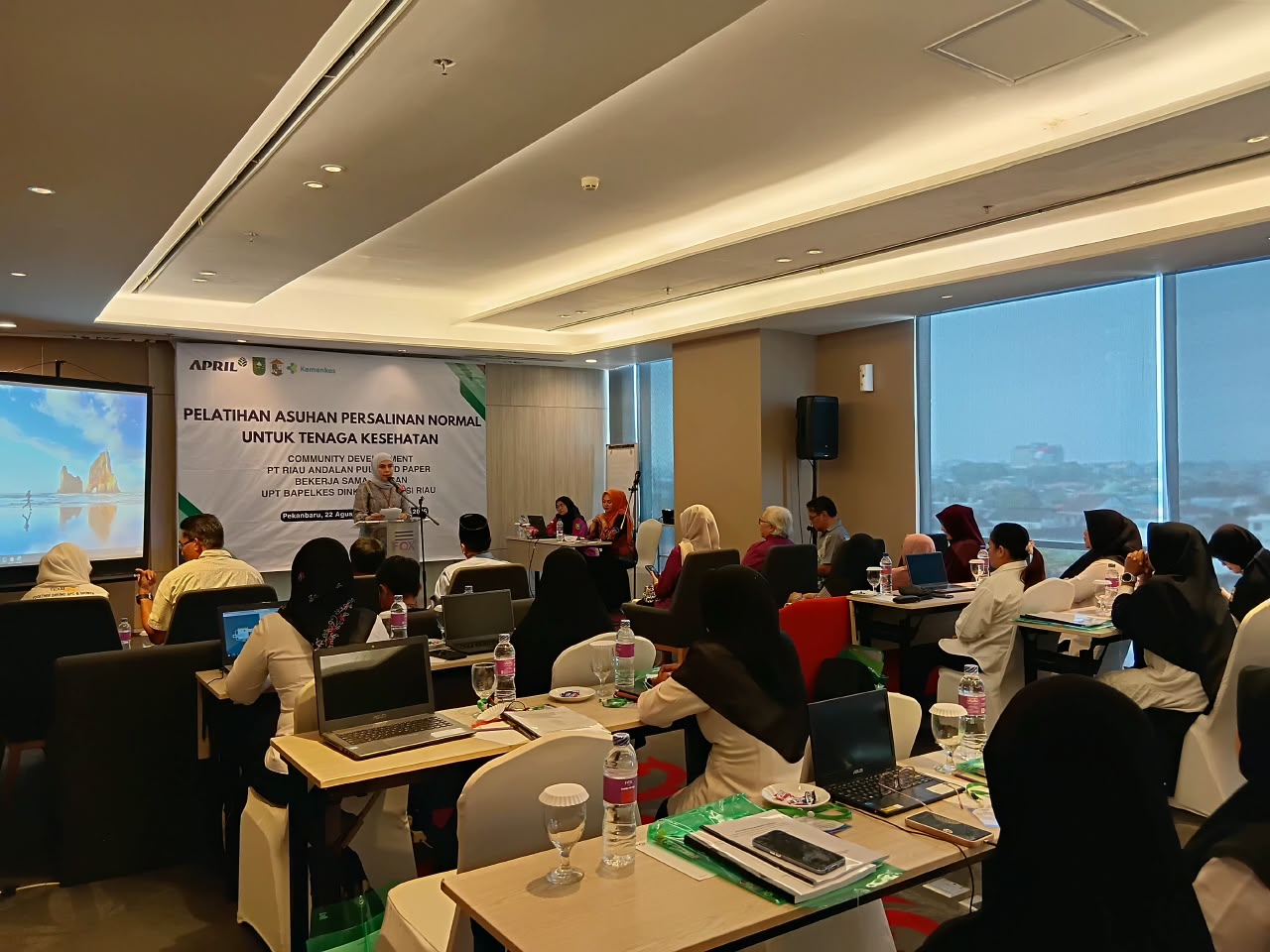
Pelatihan APN Untuk Nakes Pelalawan, Upaya Bersama Tekan Resiko Kematian Ibu dan Bayi
-
 Senin, 24 Agustus 2026 | 22:07
Pertamina Patra Niaga Raih Predikat Bintang 5 dan Boyong Penghargaan di Ajang ISEA 2026
-
-
Senin, 24 Agustus 2026 | 21:21
Six Leading Enterprises Jointly Awarded Tender for Hung Shui Kiu/Ha Tsuen Pilot Development Area
-
Senin, 24 Agustus 2026 | 21:20
Pacific Empire Announces Commencement of 2026 Diamond Drill Program at Trident and Pinnacle

-
 Selasa, 18 Agustus 2026 | 13:48
Kegiatan Bongkar Muat di Dermaga D Kawasan PT Pelindo Dumai Kembali Diduga Cemari Lingkungan
-
 Selasa, 18 Agustus 2026 | 22:35
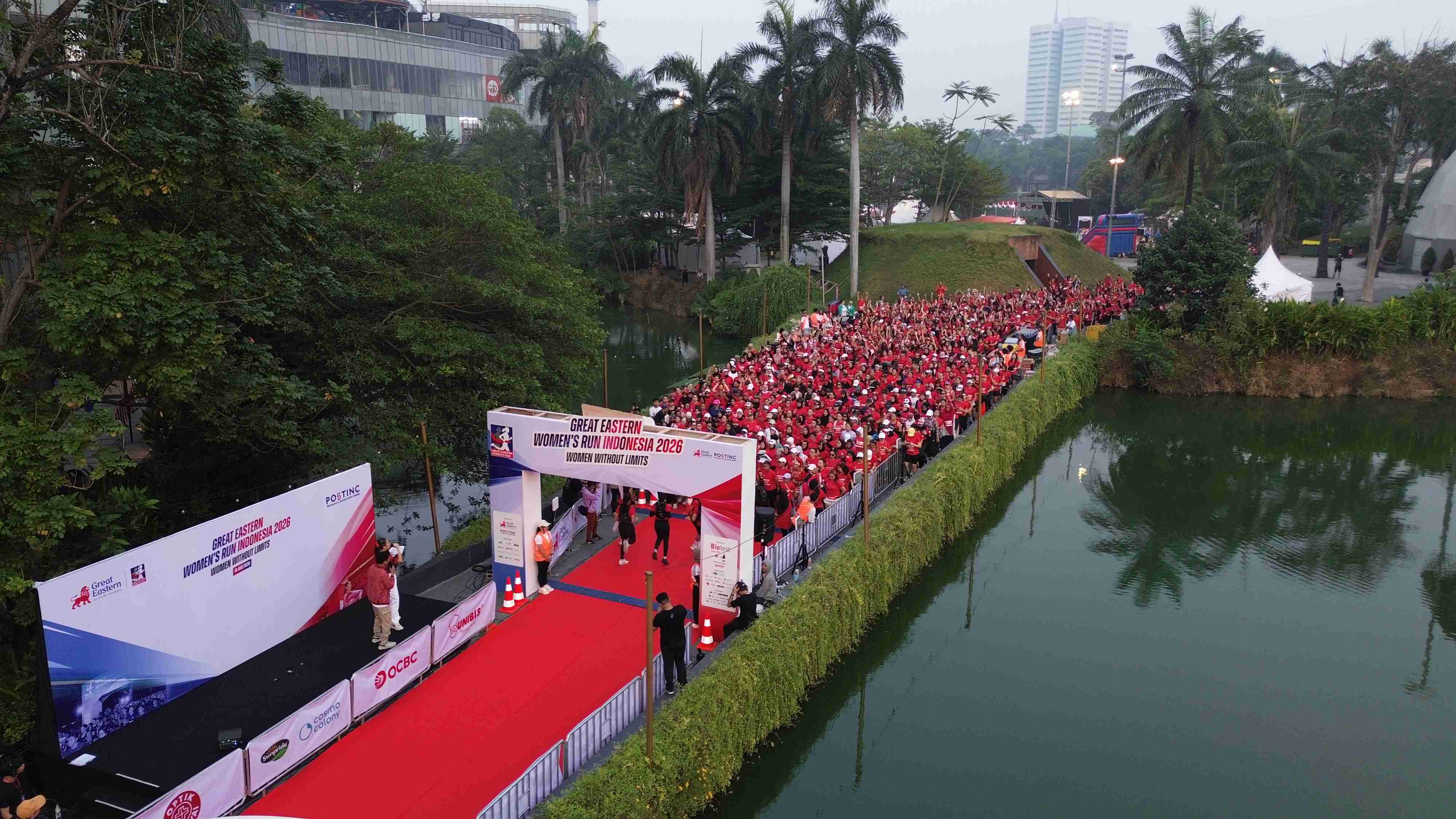
Great Eastern Women's Run Indonesia 2026 Hadirkan Pengalaman Lari yang Sehat, Suportif, dan Berdampak
-

-
 Kamis, 20 Agustus 2026 | 10:44
DP World Accelerates Contract Logistics Expansion Across Southeast Asia with New Warehouse in Malaysia
-
 Jumat, 21 Agustus 2026 | 01:59
Andrea Bocelli Merayakan Tur Peringatan 30 Tahun Romanza dengan Dua Konser Spektakuler di Indonesia
-