Menu Website

- Home
- MediaOutReach
- APAC Leads in AI Adoption but Lags in Workforce Readiness, Aon Study Finds

APAC Leads in AI Adoption but Lags in Workforce Readiness, Aon Study Finds
Rabu, 03 Juni 2026 | 13:38
SINGAPORE -
Media OutReach Newswire - 3 June 2026 -
Aon plc (NYSE: AON), a leading global professional services firm, today released insights for Asia Pacific (APAC) from its inaugural
Human Capital Trends Study,
revealing a critical gap between organisations' rapid adoption of AI
and their ability to translate it into meaningful workforce and business
outcomes.
AI Adoption Accelerates
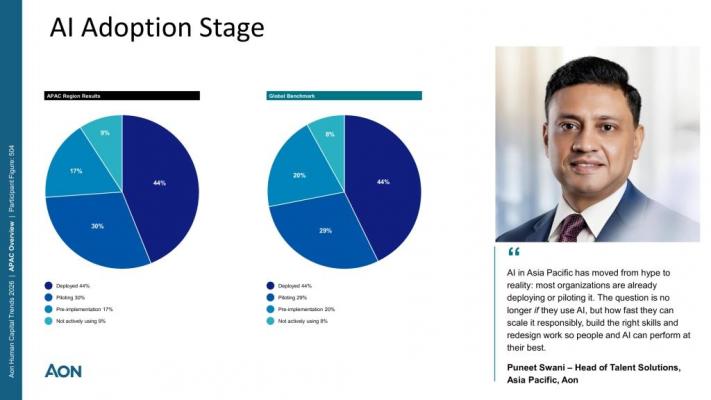
AI adoption across APAC is accelerating, with 74 percent of organisations having already deployed or piloting AI programs. The region has moved from experimentation to implementation, as organisations focus on efficiency, automation and innovation. However, talent shortages remain a structural constraint to scaling, with only 21 percent believing they can effectively recruit and retain sufficient AI talent – trailing the global average of 24 percent.
Organisations increasingly view AI as a tool to augment and reshape work rather than eliminate jobs. In APAC, 84 percent of respondents expect AI to automate certain tasks without replacing jobs entirely, while 87 percent anticipate it will create new roles requiring different skills. At the same time, 25 percent expect some job displacement as AI adoption evolves, reinforcing the need for continued investment in skills and workforce development.
"Across the Asia Pacific region, businesses are making strong progress in AI and workforce data, but technology alone will not deliver better outcomes," said Tim Dwyer, head of Human Capital in APAC for Aon. "The study highlights a critical gap between access to workforce data and the ability to act on it meaningfully. Insufficient investment in skills and workforce planning is constraining the value organisations can realise from AI. Addressing this gap will require stronger workforce planning, more personalised employee experiences and closer alignment between talent strategies and long-term business priorities – unlocking productivity gains and sustaining long-growth across the region."
APAC Lags in Personalised Employee Benefits
Employers across APAC report higher HR data maturity than the global average, enabling greater access to real-time workforce insights. Forty-two percent report high HR data maturity compared with 38 percent globally, and 74 percent having deployed or piloted AI, slightly ahead of the global level of 73 percent. This capability is supported by ongoing workforce development, with only 9 percent reporting that their workforces have not recently participated in AI reskilling or upskilling initiatives.
Despite these advancements, only 22 percent of employees in the region have access to customizable employee benefits, well below the global average of 33 percent. This is significant, given that 76 percent of APAC employees place a high value on personalised benefits, yet the majority lack access to them.
In response, organisations are focusing on three core priorities: accelerating digital transformation within HR functions, strengthening leadership and succession planning and optimising workforce planning and organisational design. Adaptability and change management are also cited as the most critical workforce skills required over the next three years, underscoring the rapid pace of business and technology change across the region.
Wellbeing and Employee Value Proposition Show Mixed Progress
While 85 percent of organisations report that their wellbeing strategy meets workforce needs, leadership visibility remains a concern, with only 26 percent reporting strong and visible commitment.
The employee value proposition (EVP) also remains underdeveloped, with just 22 percent stating that their EVP is clearly defined and understood by employees. Communication challenges persist, with information overload identified as the top barrier to effective employee engagement.
Pay Transparency and Equity Require Greater Focus
The report highlights persistent gaps in compensation practices across the region. Only 18 percent of organisations rate their pay transparency practices as mature, while 26 percent have not benchmarked employee compensation in the past year.
At the same time, 31 percent of organisations are implementing initiatives to close the gender retirement savings gap - exceeding the global average. Together, these findings show uneven progress, with continued gaps in pay equity and transparency.
"The findings demonstrate that organisations in APAC are positioning themselves to thrive in the future of work, but accelerating the shift from insight to action remains critical," said Puneet Swani, head of Talent Solutions in APAC for Aon. "Enhancing pay transparency, expanding benefits personalisation and aligning workforce strategy with business priorities will help build greater workforce resilience."
About the Report
Aon's Human Capital Trends 2026 Study surveyed 2,361 business, HR and people leaders globally, including 504 respondents from APAC across markets including Australia, China, Hong Kong, India, Malaysia, the Philippines and Singapore. More information about the report can be found here.
AI Adoption Accelerates
AI adoption across APAC is accelerating, with 74 percent of organisations having already deployed or piloting AI programs. The region has moved from experimentation to implementation, as organisations focus on efficiency, automation and innovation. However, talent shortages remain a structural constraint to scaling, with only 21 percent believing they can effectively recruit and retain sufficient AI talent – trailing the global average of 24 percent.
Organisations increasingly view AI as a tool to augment and reshape work rather than eliminate jobs. In APAC, 84 percent of respondents expect AI to automate certain tasks without replacing jobs entirely, while 87 percent anticipate it will create new roles requiring different skills. At the same time, 25 percent expect some job displacement as AI adoption evolves, reinforcing the need for continued investment in skills and workforce development.
"Across the Asia Pacific region, businesses are making strong progress in AI and workforce data, but technology alone will not deliver better outcomes," said Tim Dwyer, head of Human Capital in APAC for Aon. "The study highlights a critical gap between access to workforce data and the ability to act on it meaningfully. Insufficient investment in skills and workforce planning is constraining the value organisations can realise from AI. Addressing this gap will require stronger workforce planning, more personalised employee experiences and closer alignment between talent strategies and long-term business priorities – unlocking productivity gains and sustaining long-growth across the region."
APAC Lags in Personalised Employee Benefits
Employers across APAC report higher HR data maturity than the global average, enabling greater access to real-time workforce insights. Forty-two percent report high HR data maturity compared with 38 percent globally, and 74 percent having deployed or piloted AI, slightly ahead of the global level of 73 percent. This capability is supported by ongoing workforce development, with only 9 percent reporting that their workforces have not recently participated in AI reskilling or upskilling initiatives.
Despite these advancements, only 22 percent of employees in the region have access to customizable employee benefits, well below the global average of 33 percent. This is significant, given that 76 percent of APAC employees place a high value on personalised benefits, yet the majority lack access to them.
In response, organisations are focusing on three core priorities: accelerating digital transformation within HR functions, strengthening leadership and succession planning and optimising workforce planning and organisational design. Adaptability and change management are also cited as the most critical workforce skills required over the next three years, underscoring the rapid pace of business and technology change across the region.
Wellbeing and Employee Value Proposition Show Mixed Progress
While 85 percent of organisations report that their wellbeing strategy meets workforce needs, leadership visibility remains a concern, with only 26 percent reporting strong and visible commitment.
The employee value proposition (EVP) also remains underdeveloped, with just 22 percent stating that their EVP is clearly defined and understood by employees. Communication challenges persist, with information overload identified as the top barrier to effective employee engagement.
Pay Transparency and Equity Require Greater Focus
The report highlights persistent gaps in compensation practices across the region. Only 18 percent of organisations rate their pay transparency practices as mature, while 26 percent have not benchmarked employee compensation in the past year.
At the same time, 31 percent of organisations are implementing initiatives to close the gender retirement savings gap - exceeding the global average. Together, these findings show uneven progress, with continued gaps in pay equity and transparency.
"The findings demonstrate that organisations in APAC are positioning themselves to thrive in the future of work, but accelerating the shift from insight to action remains critical," said Puneet Swani, head of Talent Solutions in APAC for Aon. "Enhancing pay transparency, expanding benefits personalisation and aligning workforce strategy with business priorities will help build greater workforce resilience."
About the Report
Aon's Human Capital Trends 2026 Study surveyed 2,361 business, HR and people leaders globally, including 504 respondents from APAC across markets including Australia, China, Hong Kong, India, Malaysia, the Philippines and Singapore. More information about the report can be found here.
BERITA LAINNYA
Sabtu, 27 Juni 2026 | 13:05


Sabtu, 27 Juni 2026 | 13:01

Sabtu, 27 Juni 2026 | 12:58

Sabtu, 27 Juni 2026 | 12:56
Sabtu, 27 Juni 2026 | 12:56

Sabtu, 27 Juni 2026 | 12:54
Sabtu, 27 Juni 2026 | 12:54

Sabtu, 27 Juni 2026 | 12:53
Sabtu, 27 Juni 2026 | 12:52

Jumat, 26 Juni 2026 | 10:07


BERIKAN KOMENTAR


-
 Sabtu, 27 Juni 2026 | 14:27
Flash Sports & Media, Inc. Ungkap Rencana Membangun Generasi Baru Liga Kriket T20
-
 Sabtu, 27 Juni 2026 | 14:25
Perbandingan Jajaran Laptop Razer Blade 2026: Blade 14 vs Blade 16 vs Blade 18
-
 Sabtu, 27 Juni 2026 | 14:24
OneGrowth 2026: China Telecom Gelar Konferensi Mitra Global, Sambut Era Berbagi Token AI
-
-
 Sabtu, 27 Juni 2026 | 14:23
InvestHK: 413 Perusahaan Ekspansi ke Hong Kong, Bawa Investasi HK$53 Miliar dan Ciptakan 8.600 Lapangan Kerja
-
 Sabtu, 27 Juni 2026 | 14:22
Hasil Tahun Fiskal 2025/2026 HONMA Golf Tetap Solid, Penjualan dan Laba Bersih Mencatat Peningkatan Signifikan

-
-
-
 Senin, 22 Juni 2026 | 12:04
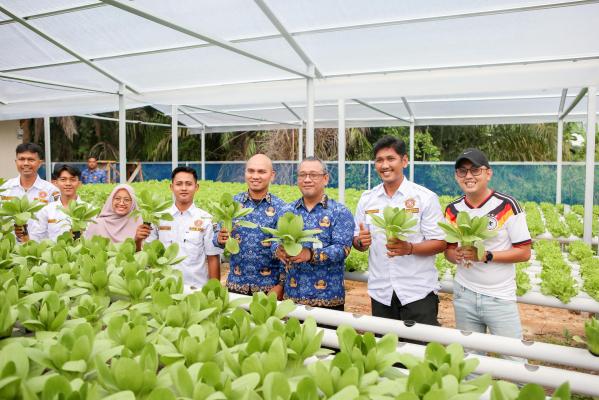
Sekda Dumai Ikuti Panen Sayuran Hidroponik Binaan Karang Taruna Kota Dumai
-
-
 Senin, 22 Juni 2026 | 11:57
SOYJOY Nutrition Award 2026 Jangkau 96 Kota, Dorong Inovasi Ahli Gizi untuk Indonesia Lebih Sehat
-