Beyond Borders: XTransfer Insights-Opportunity in the Overlooked: The Underserved SME Cross-Border Market
Beyond Borders: XTransfer Insights-Opportunity in the Overlooked: The Underserved SME Cross-Border Market
Senin, 09 Februari 2026 | 09:52
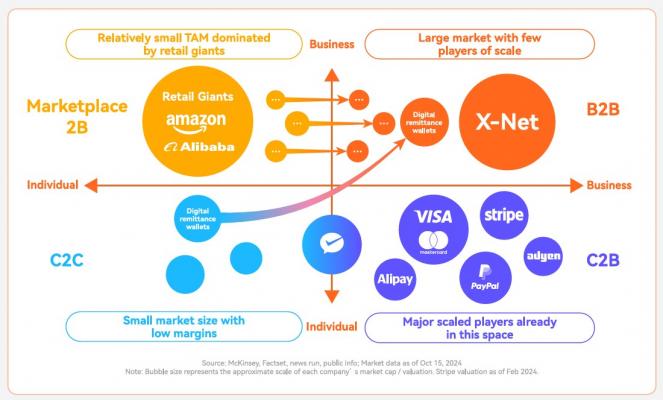
Four segments in cross-border payment industry.
HONG KONG SAR -
Media OutReach Newswire
- 9 February 2026 - According to the World Bank, SMEs account for
approximately 90% the world's businesses and contribute 65% of the
global cross-border trade. SMEs play a pivotal rolein most economies,
particularly in emerging markets. Estimates from the World Trade
Organization (WTO) and the Organization for Economic Co-operation and
Development (OECD) suggest that B2B cross-border trade payment market
for SMEs is worth approximately $20 trillion.
However, traditional commercial banks have been facing multiple
challenges in serving SMEs, including strict compliance and risk control
requirements, lower profit generating, and license limitations,
resulting in a large unmet demand through formal financial systems.
XTransfer's field research in emerging markets indicates that many SMEs
resort to illicit settlement channels like underground banks out of
necessity. In fact, the trade volume processed through these unofficial
avenues could be 2 to 5 times larger than the official import and export
figures.
Compared to other segments, B2B cross-border payment presents vast opportunities
In the cross-border payment industry, services can be categorised into four segments based on money flows:
Marketplace 2B
These businesses provide payment processing services for sellers on
e-commerce platforms. Risk control is primarily based on e-commerce
platform's integrated of data streams (e.g., merchant details,
logistics, transaction history). With relatively low technical barriers
and compliance capabilities, the industry is highly saturated.
B2B
Focused on traditional cross-border trade enterprises, this segment has
huge potential but features high risk control complexity and high
barriers. Payment service providers must individually verify the entire
information flow pertaining to each transaction (including buyer/seller
details, orders, logistics, contracts, etc.), which results in many
companies attempting to enter, but few succeed.
C2C
This primarily covers cross-border remittances between individuals. The
overall market scale is relatively small, with limited use cases.
C2B
This is the most well-established segment, dominated by cross-border
payment giants such as Visa, Mastercard, PayPal, and Stripe. The market
is saturated with intense competition.
As a reference, the C2B cross-border payment industry has evolved
dramatically over the last five decades, especially in the past ten
years. Mobile wallet providers in China, the U.S. and Europe drove the
mobile payment revolution, establishing a well-established cross-border
settlement and risk control platform dominated by card schemes and
wallets like PayPal. The system features significant advantages,
including efficient transaction processes and unified risk control
standards.
In contrast, B2B cross-border payments still primarily rely on
traditional bank transfers. The sector as a whole is still on the cusp
of the "mobile payment revolution" and has not yet formed a unified
clearing mechanism or a standardized risk control system.
The payment sector need a new platform.
However, this development gap also points to a huge market opportunity.
The B2B cross-border settlement market for SMEs desperately needs a
shake-up. Service providers that possess a deep understanding of global
customer needs and are equipped with technological and compliance
capabilities will unleash vast growth potential in this space.
Beyond Borders: XTransfer Insights is a thought-leadership series that
shares XTransfer's perspectives on the forces shaping global trade and
financial services. Through research-driven insights and real-world
observations, it highlights emerging trends, key challenges, and
opportunities across international markets.



 https://www.xtransfer.com
 https://www.linkedin.com/company/xtransfer.cn
 https://x.com/xtransferglobal
 https://www.facebook.com/XTransferGlobal/
 https://www.instagram.com/xtransfer.global















 Kamis, 16 April 2026 | 12:09
 Kamis, 16 April 2026 | 12:09

 Jumat, 10 April 2026 | 17:18

 Jumat, 10 April 2026 | 23:26