Menu Website

- Home
- MediaOutReach
- SMU Launches Resilient Workforces Institute to Strengthen Singapore's Workforce in the Age of AI

SMU Launches Resilient Workforces Institute to Strengthen Singapore's Workforce in the Age of AI
Rabu, 21 Januari 2026 | 10:03
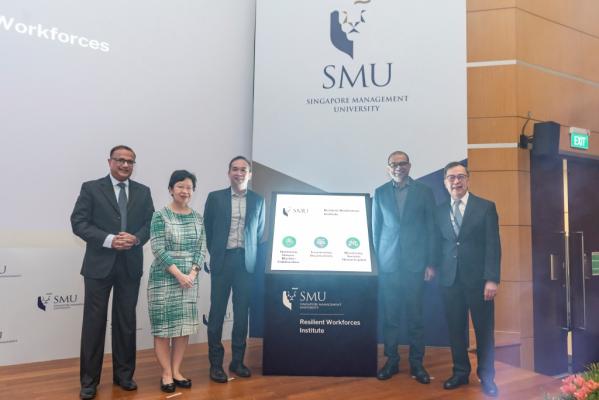
Launch of SMU Resilient Workforces Institute [right to left: Professor Alan Chan, SMU Provost, Guest-of-Honour Dr Janil Puthucheary, Senior Minister of State, Ministry of Education & Ministry of Sustainability and the Environment, Mr Tan Kok Yam, Chief Executive, SkillsFuture Singapore, Professor Lily Kong, SMU President, and Professor Archan Misra, Vice Provost (Research); Interim Director of SMU Resilient Workforces Institute]
SINGAPORE -
Media OutReach Newswire - 21 January 2026 –
Singapore Management University (SMU) today announced the launch of the
Resilient Workforces Institute (ResWORK), a new university-level
research institute advancing workforce resilience and lifelong learning
amid accelerating technological change. It is among the first institutes
in Singapore and the region to jointly study adult-learning and the
future of work through an integrated, interdisciplinary lens spanning
economics, management, behavioural science and technology.
Dr Janil Puthucheary, Senior Minister of State, Ministry of Education and Ministry of Sustainability and the Environment, graced the launch as Guest-of-Honour. In his remarks, Dr Janil highlighted the importance of partnerships with industry, enabled by research, in overcoming workforce disruptions brought about by artificial intelligence (AI) and digital technologies.
Professor Lily Kong, President, Singapore Management University, said: "The launch of the Resilient Workforces Institute reflects SMU's commitment to research that matters – research that shapes public policy, informs organisational practice and ultimately strengthens the resilience of Singapore's workforce. By bringing together insights across disciplines, ResWORK will help Singapore and the region navigate the profound changes reshaping work and learning in the age of AI."
ResWORK will serve as a focal point for trans-disciplinary research across SMU, organised around three core pillars:
These early projects reflect the Institute's emphasis on applied, policy-relevant research developed in collaboration with public agencies and industry partners. (Note: See Annex A for a list of research projects that were awarded seed grants.)
SMU has committed S$5 million over five years to anchor the Institute, with a goal of securing an additional S$8 million in external research funding within three years, enabling ResWORK to scale its partnerships and research programmes over time.
Professor Archan Misra, Vice Provost (Research) and Interim Director of ResWORK, said: "ResWORK is built on the belief that AI-led change will reshape opportunity rather than displace it. Our research agenda is designed to move beyond diagnosis to solutioning—working with government agencies, employers and other partners to generate evidence that informs policy, organisational practice and lifelong learning systems. I'm enthused to see how colleagues across the spectrum of Management, Economics and Computing disciplines have already come together to collectively frame a positive research agenda that formulates AI-led workplace transformations as an economic opportunity, as well as a driver of innovations in adult learning practices. The launch builds on momentum that is already underway and marks the start of SMU's sustained efforts to help shape a resilient, future-ready workforce."
Anchoring National Workforce Priorities through Collaboration with SkillsFuture Singapore
At the launch, SMU and SkillsFuture Singapore (SSG) also signed a two-year Memorandum of Understanding (MoU) to mutually identify and drive strategic research on how Artificial Intelligence (AI), digital technologies, and generational changes in work preferences are transforming job tasks, skills demand and career and learning pathways, and translate these insights into policies that sustain employability and inclusive growth.
In addition, it will look into how adult learning systems can be redesigned for higher participation, retention and impact, and how organisations can combine human and machine capabilities to raise productivity while preserving meaningful work.
Mr Tan Kok Yam, Chief Executive of SkillsFuture Singapore said: "Our partnership with SMU on ResWORK is driven by a singular objective: to future-proof the national SkillsFuture system. By future-proofing, we mean that adult learning must adapt to the effects of emerging, rapidly changing technologies to workforce dynamics, so that the training received by learners best equips them for these changes. The system also must acquire a deep understanding of what employers want from their workers, where and how jobs have changed in nature, and what skills and attributes allow workers to best succeed. ResWORK seeks to help build such capabilities for our national adult training system."
Industry Partnerships Driving Applied Research on AI Disruption and Workforce Resilience
Complementing the national collaboration with SSG, ResWORK will work with industry partners to translate research into practice.
SMU received a contribution of S$450,000 from Equinix to advance applied research under ResWORK. The contribution will support a flagship systemic research project on occupational exposure to AI within Singapore's labour market.
Led by Professor Li Jia, Dean, School of Economics; Lee Kong Chian Professor of Economics; (courtesy appointment in the Lee Kong Chian School of Business) Econometrics Lead, SMU Urban Institute, the study will develop Singapore's leading reproducible, transparent and publicly accessible index measuring AI exposure in new job vacancies across occupations, industries and worker segments. By analysing job advertisements and task requirements over time, the research will track how AI-related skills and task demands are evolving, and generate insights to inform workforce planning, reskilling programmes and employment policy.
This collaboration marks the first corporate-funded research initiative under ResWORK and reflects the Institute's emphasis on data-driven, policy-relevant research with real-world impact.
Said Ms Leong Yee May, Managing Director, Equinix Singapore, "Equinix and SMU have enjoyed a long and collaborative partnership aimed at building a sustainable digital future. By partnering with SMU on its Resilient Workforce initiative, we're investing in research that will help position Singapore as a regional leader on AI and the future of work, informing the design of targeted policies like reskilling programs."
Annex A: ResWORK Seed-Funded Research Projects
Ahead of its formal launch, the Resilient Workforces Institute (ResWORK) has initiated nine seed-funded research projects, reflecting early momentum and active collaboration across SMU's schools. These projects are organised around ResWORK's three core pillars and focus on applied, policy-relevant research in partnership with public and private organisations.
Pillar 1: Optimising Human-Machine Collaboration
Research on technologies and tools (AR/VR, AI) that enable individuals to both learn and execute future tasks in collaboration with AI, machines and robots.
1. Artificial Intelligence in Higher Education: Evaluating AI Outputs and Metacognition of Law Students
Theme: Technologies for Augmenting Adult Learning
Principal Investigator: Gary CHAN Kok Yew, Full-time Faculty, Professor of Law, Yong Pung How School of Law
Why this matters: As AI tools enter education and professional training, this project examines how law students learn to critically evaluate AI outputs and reflect on them as part of their training to be legal professionals in the near future.
About the Project: This project examines how law students assess AI-generated legal reasoning, focusing on metacognitive awareness, reflective judgment, and responsible AI use. Using tort law as a testbed, it studies how learners adopt, revise or reject AI outputs, and identifies best practices for evaluating accuracy, clarity and reasoning quality. The findings will inform ethical AI integration in education and professional training.
Research Impact: Supporting and enhancing law students' critical evaluation of and reflective judgement on AI outputs
2. Unfolding Motivation in Adult Learning with Generative AI
Theme: Technologies for Augmenting Adult Learning
Principal Investigator: NGO Chong Wah, Full-time Faculty, Lee Kong Chian Professor of Computer Science, Director, Human-Machine Collaborative Systems Cluster, ResWORK Fellow, School of Computing and Information Systems
Co-PI: Gary Pan @ SOA; Clarence Goh @ SOA; Venky Shankararaman @ SCIS; Dragan Gasevic @ Monash University
Why this matters: Mid-career workers are expected to reskill continuously, yet motivation and engagement remain major barriers to lifelong learning.
About the Project: This project investigates how generative AI can personalise adult learning to sustain motivation among mid-career learners balancing work, study and life demands. It develops a GenAI-powered learning system that provides conversational, self-regulated learning support through interaction with large language models. By analysing learning behaviour, dialogue patterns and behavioural signals, the research identifies how AI-driven scaffolding can improve engagement and learning persistence in adult education.
Research Impact: This project aims to uncover motivational processes in adult learning to inform the design of AI learning systems.
3. Building Reflection Competencies for Human-AI Collaboration: A Multi-Agent Training System
Theme: Changing Professional Practices in the Workplace
Principal Investigator: NAH, Fiona Fui-Hoon, Full-time Faculty, Professor of Information Systems, ResWORK Fellow, School of Computing and Information Systems
Collaborators: Jiaqi WU YOUNG, PhD student @ SCIS; Ming WANG, Visiting PG Research student @ SCIS
Why this matters: Organisations often adopt AI faster than workers develop the skills to critically evaluate it, leading to over reliance or under reliance, declining judgment and missed productivity gains.
About the Project: This project addresses the problem of "cognitive debt" in AI-enabled workplaces by developing a multi-agent reflection training system embedded in AI tools. Drawing on motivation and behavioural theories, it designs and tests interventions that encourage users to reflect on, scrutinise and evaluate AI outputs. The research aims to provide scalable training approaches that balance AI adoption with human judgment and oversight.
Research Impact: Overcoming AI users' cognitive debt through reflection training for a resilient workforce
4. Adaptive Skill Transfer: Reinforcement-Learned Scaffolding for Cognitive Personalisation in Adult Learning
Theme: Adult Learning Transfer
Principal Investigator: Pradeep Reddy VARAKANTHAM, Full-time Faculty, Professor of Computer Science, Director, CARE.AI Lab, Coordinator, BSc (CS) Artificial Intelligence Track, School of Computing and Information Systems
Co-PI: Annabel Chen Shen-Hsing, NTU
Collaborator: Swapna Gottipati @ SCIS, SMU
Why this matters: Reskilling often fails because learning systems ignore the cognitive strengths adults already possess.
About the Project: This research explores how adaptive AI systems can accelerate adult learning by leveraging existing reasoning and problem-solving abilities. Implemented within an adaptive learning platform, the project uses cognitive assessment and reinforcement learning to personalise both content and thinking strategies. By making skill transfer explicit and efficient, the study aims to improve learning speed, retention and reskilling outcomes.
Research Impact: Transforming adult reskilling from simple content delivery into a personalised, AI-driven bridge that leverages existing reasoning strengths to accelerate the mastery of complex skills
5. The Effects of AI-Based Cognitive Offloading on Metacognitive Skills and Learning Transfer in Adult Professional Learners
Theme: Adult Learning Transfer
Principal Investigator: YANG Hwajin, Full-time Faculty, Professor of Psychology, Associate Dean (Research), Lee Kong Chian Fellow, ResWORK Fellow, School of Social Sciences
Co-PI: Sarah Wong @ SOSS; Gary Pan @ SOA; Andree Hartanto @ SOSS
Collaborator: Wong Zi Yang, Research Fellow, SMU
Why this matters: While AI can make work easier, excessive reliance on it may weaken learning, judgment, and long-term skill development.
About the Project: This project examines how using AI tools affects adult learners'
metacognitive awareness (monitoring and regulating one's learning) and learning transfer (applying knowledge to new situations) in professional development. Using a randomised controlled design, the study compares guided and unguided AI use to determine whether guided AI use enhances these cognitive skills or if unguided use undermines them through excessive cognitive offloading.
Research Impact: The findings will inform the development of AI-enabled training frameworks that promote durable learning, reflective thinking, and transferable skills among working adults.
6. Towards Measurable, Governed Onboarding for Human–AI Teams
Theme: Open Category
Principal Investigator: LEE, Min Hun, Full-time Faculty, Assistant Professor of Computer Science, School of Computing and Information Systems
Why this matters: AI adoption often fails not because of model accuracy, but because of people and workflow – users do not know when to trust, question or correct AI systems.
About the Project: This project transforms AI onboarding into an interactive, measurable learning experience that teaches users how to collaborate effectively with AI. Using a structured "Understand-Control-Improve" framework, it develops tools that promote calibrated trust, explainability, and safe intervention. The research aims to establish robust methods for governed human-AI collaboration in real-world decision-making workflows.
Research Impact: This project develops measurable, governed methods for human-AI collaboration that enable safe and effective AI adoption in real-world decision-making workflows.
PILLAR #2: TRANSFORMING ORGANISATIONS
7. Valuing Flexible Work Arrangements: A Discrete Choice Experiment with Employers and Employees in Singapore
Theme: Changing Professional Practices in the Workplace
Pillar: #2 / #3
Principal Investigator: KIM Seonghoon, Full-time Faculty, Associate Professor of Economics, Deputy Director, Centre for Research on Successful Ageing (ROSA), School of Economics
Co-PI: Cao Wenjia @ SOE, SMU
Collaborator: Kanghyock Koh, Korea University
Why this matters: Flexible work is now a national priority, yet evidence on its true value to employers and employees remains limited.
About the Project: This study quantifies how employers and employees value flexible work arrangements using large-scale discrete choice experiments. By estimating wage-equivalent trade-offs for different forms of flexibility, it provides evidence to inform organisational decisions and policy implementation following Singapore's Tripartite Guidelines on Flexible Work Arrangement Requests. The research supports more sustainable, inclusive and productive workplace design.
8. Job insecurity and employee motivation
Theme: Changing Professional Practices in the Workplace
Principal Investigator: Nina SIROLA, Full-time Faculty, Assistant Professor of Organisational Behaviour & Human Resources, ResWORK Fellow, Lee Kong Chian School of Business
Why this matters: Rising job insecurity can quietly erode motivation and performance, even in organisations investing heavily in transformation.
About the Project: This project examines how managers' beliefs about job-insecure employees influence leadership behaviour and intrinsic motivation. Rather than focusing only on worker stress, it identifies manager-driven mechanisms that can either undermine or sustain motivation. Through experimental and field studies, the research develops low-cost leadership interventions to support employee engagement and well-being during periods of uncertainty.
Research Impact: This project highlights how managers' beliefs and leadership behaviours can either undermine or sustain the intrinsic motivation of job-insecure workers, pointing to a low-cost, belief-based lever for resilience.
PILLAR #3: MAXIMISING SOCIETAL HUMAN CAPITAL
9. Measuring the Impact of AI and Large Language Models on Singapore's Labour Market: Constructing a Task-Level Exposure Index
Theme: Open Category
Principal Investigator: LI Jia, Full-time Faculty, Dean, School of Economics, Lee Kong Chian, Professor of Economics, Econometrics Lead, SMU Urban Institute
(courtesy appointment in the Lee Kong Chian School of Business)
Collaborator: Zhang Dandan, Peking University
Why this matters: Policymakers and employers need clear evidence on which jobs are most exposed to AI, and which are likely to benefit from it.
About the Project: This project develops Singapore's first task-level AI-LLM Exposure Index by combining job posting data with detailed task information. Using novel econometric methods to address measurement uncertainty, it distinguishes between complementary and substitutive effects of AI on human labour. The resulting indices will inform workforce planning, reskilling strategies and national employment policy.
Research Impact: Measuring AI's disruptive and enabling effects on Singapore's labour market
Dr Janil Puthucheary, Senior Minister of State, Ministry of Education and Ministry of Sustainability and the Environment, graced the launch as Guest-of-Honour. In his remarks, Dr Janil highlighted the importance of partnerships with industry, enabled by research, in overcoming workforce disruptions brought about by artificial intelligence (AI) and digital technologies.
Professor Lily Kong, President, Singapore Management University, said: "The launch of the Resilient Workforces Institute reflects SMU's commitment to research that matters – research that shapes public policy, informs organisational practice and ultimately strengthens the resilience of Singapore's workforce. By bringing together insights across disciplines, ResWORK will help Singapore and the region navigate the profound changes reshaping work and learning in the age of AI."
ResWORK will serve as a focal point for trans-disciplinary research across SMU, organised around three core pillars:
- - Optimising Human-Machine Collaboration: enabling workers to learn and perform effectively alongside AI, machines and robotics
- - Transforming Organisations: redesigning business processes, leadership and work practices for AI-enabled workplaces
- - Maximising Societal Human Capital: analysing labour-market transitions and shaping policies that promote inclusive, gainful employment
Research momentum has already begun ahead of the formal launch, with
ResWORK having secured the participation of several globally renowned
visiting scholars and over
20 faculty members across SMU's six schools. ResWORK faculty has recently initiated
nine internally seed-funded research projects, as well as
multiple externally funded research programs,
collectively worth over S$1.5 million in funding.
These early projects reflect the Institute's emphasis on applied, policy-relevant research developed in collaboration with public agencies and industry partners. (Note: See Annex A for a list of research projects that were awarded seed grants.)
SMU has committed S$5 million over five years to anchor the Institute, with a goal of securing an additional S$8 million in external research funding within three years, enabling ResWORK to scale its partnerships and research programmes over time.
Professor Archan Misra, Vice Provost (Research) and Interim Director of ResWORK, said: "ResWORK is built on the belief that AI-led change will reshape opportunity rather than displace it. Our research agenda is designed to move beyond diagnosis to solutioning—working with government agencies, employers and other partners to generate evidence that informs policy, organisational practice and lifelong learning systems. I'm enthused to see how colleagues across the spectrum of Management, Economics and Computing disciplines have already come together to collectively frame a positive research agenda that formulates AI-led workplace transformations as an economic opportunity, as well as a driver of innovations in adult learning practices. The launch builds on momentum that is already underway and marks the start of SMU's sustained efforts to help shape a resilient, future-ready workforce."
Anchoring National Workforce Priorities through Collaboration with SkillsFuture Singapore
At the launch, SMU and SkillsFuture Singapore (SSG) also signed a two-year Memorandum of Understanding (MoU) to mutually identify and drive strategic research on how Artificial Intelligence (AI), digital technologies, and generational changes in work preferences are transforming job tasks, skills demand and career and learning pathways, and translate these insights into policies that sustain employability and inclusive growth.
In addition, it will look into how adult learning systems can be redesigned for higher participation, retention and impact, and how organisations can combine human and machine capabilities to raise productivity while preserving meaningful work.
Mr Tan Kok Yam, Chief Executive of SkillsFuture Singapore said: "Our partnership with SMU on ResWORK is driven by a singular objective: to future-proof the national SkillsFuture system. By future-proofing, we mean that adult learning must adapt to the effects of emerging, rapidly changing technologies to workforce dynamics, so that the training received by learners best equips them for these changes. The system also must acquire a deep understanding of what employers want from their workers, where and how jobs have changed in nature, and what skills and attributes allow workers to best succeed. ResWORK seeks to help build such capabilities for our national adult training system."
Industry Partnerships Driving Applied Research on AI Disruption and Workforce Resilience
Complementing the national collaboration with SSG, ResWORK will work with industry partners to translate research into practice.
SMU received a contribution of S$450,000 from Equinix to advance applied research under ResWORK. The contribution will support a flagship systemic research project on occupational exposure to AI within Singapore's labour market.
Led by Professor Li Jia, Dean, School of Economics; Lee Kong Chian Professor of Economics; (courtesy appointment in the Lee Kong Chian School of Business) Econometrics Lead, SMU Urban Institute, the study will develop Singapore's leading reproducible, transparent and publicly accessible index measuring AI exposure in new job vacancies across occupations, industries and worker segments. By analysing job advertisements and task requirements over time, the research will track how AI-related skills and task demands are evolving, and generate insights to inform workforce planning, reskilling programmes and employment policy.
This collaboration marks the first corporate-funded research initiative under ResWORK and reflects the Institute's emphasis on data-driven, policy-relevant research with real-world impact.
Said Ms Leong Yee May, Managing Director, Equinix Singapore, "Equinix and SMU have enjoyed a long and collaborative partnership aimed at building a sustainable digital future. By partnering with SMU on its Resilient Workforce initiative, we're investing in research that will help position Singapore as a regional leader on AI and the future of work, informing the design of targeted policies like reskilling programs."
###
Annex A: ResWORK Seed-Funded Research Projects
Ahead of its formal launch, the Resilient Workforces Institute (ResWORK) has initiated nine seed-funded research projects, reflecting early momentum and active collaboration across SMU's schools. These projects are organised around ResWORK's three core pillars and focus on applied, policy-relevant research in partnership with public and private organisations.
Pillar 1: Optimising Human-Machine Collaboration
Research on technologies and tools (AR/VR, AI) that enable individuals to both learn and execute future tasks in collaboration with AI, machines and robots.
1. Artificial Intelligence in Higher Education: Evaluating AI Outputs and Metacognition of Law Students
Theme: Technologies for Augmenting Adult Learning
Principal Investigator: Gary CHAN Kok Yew, Full-time Faculty, Professor of Law, Yong Pung How School of Law
Why this matters: As AI tools enter education and professional training, this project examines how law students learn to critically evaluate AI outputs and reflect on them as part of their training to be legal professionals in the near future.
About the Project: This project examines how law students assess AI-generated legal reasoning, focusing on metacognitive awareness, reflective judgment, and responsible AI use. Using tort law as a testbed, it studies how learners adopt, revise or reject AI outputs, and identifies best practices for evaluating accuracy, clarity and reasoning quality. The findings will inform ethical AI integration in education and professional training.
Research Impact: Supporting and enhancing law students' critical evaluation of and reflective judgement on AI outputs
2. Unfolding Motivation in Adult Learning with Generative AI
Theme: Technologies for Augmenting Adult Learning
Principal Investigator: NGO Chong Wah, Full-time Faculty, Lee Kong Chian Professor of Computer Science, Director, Human-Machine Collaborative Systems Cluster, ResWORK Fellow, School of Computing and Information Systems
Co-PI: Gary Pan @ SOA; Clarence Goh @ SOA; Venky Shankararaman @ SCIS; Dragan Gasevic @ Monash University
Why this matters: Mid-career workers are expected to reskill continuously, yet motivation and engagement remain major barriers to lifelong learning.
About the Project: This project investigates how generative AI can personalise adult learning to sustain motivation among mid-career learners balancing work, study and life demands. It develops a GenAI-powered learning system that provides conversational, self-regulated learning support through interaction with large language models. By analysing learning behaviour, dialogue patterns and behavioural signals, the research identifies how AI-driven scaffolding can improve engagement and learning persistence in adult education.
Research Impact: This project aims to uncover motivational processes in adult learning to inform the design of AI learning systems.
3. Building Reflection Competencies for Human-AI Collaboration: A Multi-Agent Training System
Theme: Changing Professional Practices in the Workplace
Principal Investigator: NAH, Fiona Fui-Hoon, Full-time Faculty, Professor of Information Systems, ResWORK Fellow, School of Computing and Information Systems
Collaborators: Jiaqi WU YOUNG, PhD student @ SCIS; Ming WANG, Visiting PG Research student @ SCIS
Why this matters: Organisations often adopt AI faster than workers develop the skills to critically evaluate it, leading to over reliance or under reliance, declining judgment and missed productivity gains.
About the Project: This project addresses the problem of "cognitive debt" in AI-enabled workplaces by developing a multi-agent reflection training system embedded in AI tools. Drawing on motivation and behavioural theories, it designs and tests interventions that encourage users to reflect on, scrutinise and evaluate AI outputs. The research aims to provide scalable training approaches that balance AI adoption with human judgment and oversight.
Research Impact: Overcoming AI users' cognitive debt through reflection training for a resilient workforce
4. Adaptive Skill Transfer: Reinforcement-Learned Scaffolding for Cognitive Personalisation in Adult Learning
Theme: Adult Learning Transfer
Principal Investigator: Pradeep Reddy VARAKANTHAM, Full-time Faculty, Professor of Computer Science, Director, CARE.AI Lab, Coordinator, BSc (CS) Artificial Intelligence Track, School of Computing and Information Systems
Co-PI: Annabel Chen Shen-Hsing, NTU
Collaborator: Swapna Gottipati @ SCIS, SMU
Why this matters: Reskilling often fails because learning systems ignore the cognitive strengths adults already possess.
About the Project: This research explores how adaptive AI systems can accelerate adult learning by leveraging existing reasoning and problem-solving abilities. Implemented within an adaptive learning platform, the project uses cognitive assessment and reinforcement learning to personalise both content and thinking strategies. By making skill transfer explicit and efficient, the study aims to improve learning speed, retention and reskilling outcomes.
Research Impact: Transforming adult reskilling from simple content delivery into a personalised, AI-driven bridge that leverages existing reasoning strengths to accelerate the mastery of complex skills
5. The Effects of AI-Based Cognitive Offloading on Metacognitive Skills and Learning Transfer in Adult Professional Learners
Theme: Adult Learning Transfer
Principal Investigator: YANG Hwajin, Full-time Faculty, Professor of Psychology, Associate Dean (Research), Lee Kong Chian Fellow, ResWORK Fellow, School of Social Sciences
Co-PI: Sarah Wong @ SOSS; Gary Pan @ SOA; Andree Hartanto @ SOSS
Collaborator: Wong Zi Yang, Research Fellow, SMU
Why this matters: While AI can make work easier, excessive reliance on it may weaken learning, judgment, and long-term skill development.
About the Project: This project examines how using AI tools affects adult learners'
metacognitive awareness (monitoring and regulating one's learning) and learning transfer (applying knowledge to new situations) in professional development. Using a randomised controlled design, the study compares guided and unguided AI use to determine whether guided AI use enhances these cognitive skills or if unguided use undermines them through excessive cognitive offloading.
Research Impact: The findings will inform the development of AI-enabled training frameworks that promote durable learning, reflective thinking, and transferable skills among working adults.
6. Towards Measurable, Governed Onboarding for Human–AI Teams
Theme: Open Category
Principal Investigator: LEE, Min Hun, Full-time Faculty, Assistant Professor of Computer Science, School of Computing and Information Systems
Why this matters: AI adoption often fails not because of model accuracy, but because of people and workflow – users do not know when to trust, question or correct AI systems.
About the Project: This project transforms AI onboarding into an interactive, measurable learning experience that teaches users how to collaborate effectively with AI. Using a structured "Understand-Control-Improve" framework, it develops tools that promote calibrated trust, explainability, and safe intervention. The research aims to establish robust methods for governed human-AI collaboration in real-world decision-making workflows.
Research Impact: This project develops measurable, governed methods for human-AI collaboration that enable safe and effective AI adoption in real-world decision-making workflows.
PILLAR #2: TRANSFORMING ORGANISATIONS
7. Valuing Flexible Work Arrangements: A Discrete Choice Experiment with Employers and Employees in Singapore
Theme: Changing Professional Practices in the Workplace
Pillar: #2 / #3
Principal Investigator: KIM Seonghoon, Full-time Faculty, Associate Professor of Economics, Deputy Director, Centre for Research on Successful Ageing (ROSA), School of Economics
Co-PI: Cao Wenjia @ SOE, SMU
Collaborator: Kanghyock Koh, Korea University
Why this matters: Flexible work is now a national priority, yet evidence on its true value to employers and employees remains limited.
About the Project: This study quantifies how employers and employees value flexible work arrangements using large-scale discrete choice experiments. By estimating wage-equivalent trade-offs for different forms of flexibility, it provides evidence to inform organisational decisions and policy implementation following Singapore's Tripartite Guidelines on Flexible Work Arrangement Requests. The research supports more sustainable, inclusive and productive workplace design.
8. Job insecurity and employee motivation
Theme: Changing Professional Practices in the Workplace
Principal Investigator: Nina SIROLA, Full-time Faculty, Assistant Professor of Organisational Behaviour & Human Resources, ResWORK Fellow, Lee Kong Chian School of Business
Why this matters: Rising job insecurity can quietly erode motivation and performance, even in organisations investing heavily in transformation.
About the Project: This project examines how managers' beliefs about job-insecure employees influence leadership behaviour and intrinsic motivation. Rather than focusing only on worker stress, it identifies manager-driven mechanisms that can either undermine or sustain motivation. Through experimental and field studies, the research develops low-cost leadership interventions to support employee engagement and well-being during periods of uncertainty.
Research Impact: This project highlights how managers' beliefs and leadership behaviours can either undermine or sustain the intrinsic motivation of job-insecure workers, pointing to a low-cost, belief-based lever for resilience.
PILLAR #3: MAXIMISING SOCIETAL HUMAN CAPITAL
9. Measuring the Impact of AI and Large Language Models on Singapore's Labour Market: Constructing a Task-Level Exposure Index
Theme: Open Category
Principal Investigator: LI Jia, Full-time Faculty, Dean, School of Economics, Lee Kong Chian, Professor of Economics, Econometrics Lead, SMU Urban Institute
(courtesy appointment in the Lee Kong Chian School of Business)
Collaborator: Zhang Dandan, Peking University
Why this matters: Policymakers and employers need clear evidence on which jobs are most exposed to AI, and which are likely to benefit from it.
About the Project: This project develops Singapore's first task-level AI-LLM Exposure Index by combining job posting data with detailed task information. Using novel econometric methods to address measurement uncertainty, it distinguishes between complementary and substitutive effects of AI on human labour. The resulting indices will inform workforce planning, reskilling strategies and national employment policy.
Research Impact: Measuring AI's disruptive and enabling effects on Singapore's labour market
BERITA LAINNYA
Rabu, 21 Januari 2026 | 10:07

Rabu, 21 Januari 2026 | 10:05
Rabu, 21 Januari 2026 | 10:03

Rabu, 21 Januari 2026 | 09:54


Rabu, 21 Januari 2026 | 09:07

Rabu, 21 Januari 2026 | 09:04

Rabu, 21 Januari 2026 | 09:03
Rabu, 21 Januari 2026 | 09:02

Rabu, 21 Januari 2026 | 09:01

BERIKAN KOMENTAR


-

-
 Rabu, 21 Januari 2026 | 10:22
Vinova Kembali Masuk Daftar Perusahaan dengan Pertumbuhan Tercepat di Singapura 2026
-
 Rabu, 21 Januari 2026 | 10:22
Sanya Siap Jadi Tuan Rumah Asian Beach Games ke-6, Persiapan Masuki Hitung Mundur 100 Hari
-

-
 Rabu, 21 Januari 2026 | 10:21
Huawei: Otomatisasi, Digitalisasi, dan AI sebagai Penggerak Utama Modernisasi Jaringan Listrik
-


-
 Sabtu, 17 Januari 2026 | 21:40
Soroti Potensi Bancakan Anggaran, MASAKO Dumai Siap Gelar Seminar Anti Korupsi
-
 Sabtu, 17 Januari 2026 | 08:58
ONYX Hospitality Group Partners with Yee Fung Group to Launch "Y Hotel Nanshan Shenzhen", Expanding its Portfolio in China
-
 Sabtu, 17 Januari 2026 | 09:00
Local Brands on Shopee Evolve to Meet the Needs of the Modern Chinese New Year Shopper
-
 Sabtu, 17 Januari 2026 | 09:36
Merek Lokal di Shopee Berinovasi untuk Menyesuaikan Diri dengan Kebutuhan Pembeli Modern di Tahun Baru Imlek
-
 Sabtu, 17 Januari 2026 | 09:36
VinFast VF 8 Menjadi Pilihan Global Berkat Performa Andal dan Kenyamanan Sehari-hari
-
 Sabtu, 17 Januari 2026 | 09:35
AFERIY Luncurkan Nomad1800, Pembangkit Listrik Portabel Generasi Terbaru di CES 2026