Menu Website

- Home
- MediaOutReach
- Security Is the New Market Access: Kigen Is Leading the IoT Security Mandate

Security Is the New Market Access: Kigen Is Leading the IoT Security Mandate
Jumat, 26 Juni 2026 | 09:51
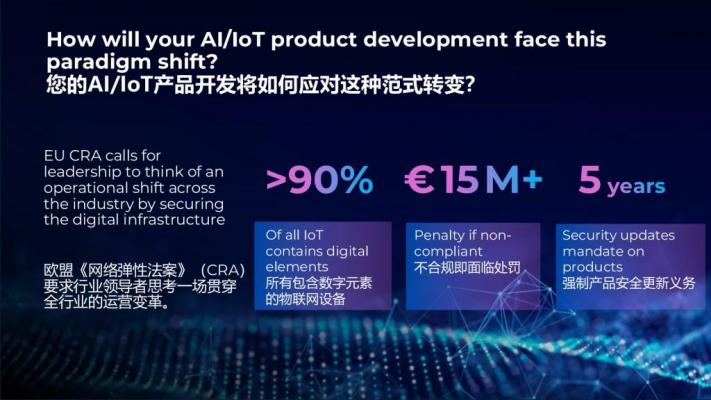
Speaking at MWCShanghai, Mr Jean-Louis Carrara, SVP of Kigen presented the challenge for industry leadership in electronics exports and pragmatic, cost-effective interventions immediately available.
At MWC IoT Summit 2026, Kigen made the case that the EU Cyber Resilience Act is not a compliance burden — it is a once-in-a-generation opportunity. For manufacturers who move now, the competitive advantage is structural.
At MWC IoT Summit 2026 in Shanghai, Jean-Louis Carrara, SVP Global Sales at Kigen, delivered a keynote that reframed this challenge as an inflection point. The message was clear: the era of voluntary security is over, and the manufacturers who recognise this first will define the competitive landscape for the decade ahead.
The Regulation That Changes Everything
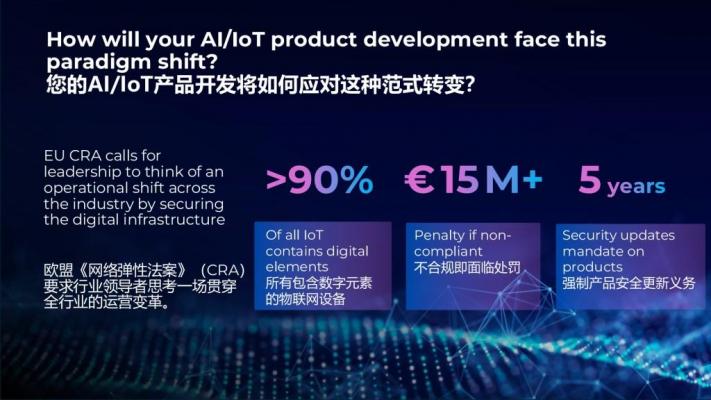
The EU Cyber Resilience Act (CRA) is the most significant cybersecurity legislation ever enacted. It covers more than 90% of all IoT products containing digital elements — sensors, gateways, industrial equipment, consumer devices. If it connects, it is covered.
Manufacturers must now provide security updates across a five-year product lifecycle, report confirmed security incidents within 72 hours, and demonstrate security by design from the earliest stages of product development. Non-compliance carries penalties of up to €15 million, or 2.5% of global annual turnover.
Documentation requirements and vulnerability management obligations are already in force from September 2026. For any product in development today — any product planned for market entry in 2027 — compliance is not a future consideration. It is a present one.
"Security is no longer a cost to be minimised. It is an
investment in market access, competitive standing, and long-term
resilience."
Independent analysis puts the average cost of CRA compliance at approximately €100,000 per product line. Against a potential penalty exposure of €15 million, the arithmetic is straightforward. But Carrara pressed further: as the compliance threshold rises, EU market access becomes selectively available — a structural advantage for those who are ready.
This is the reframe that matters. Security is not a constraint on speed to market. It is the enabler of access to the world's most demanding — and most rewarding — markets.
Proof at Scale — and Under Pressure
Kigen's eSIM technology operates across more than 250 terrestrial and satellite networks worldwide. Hundreds of millions of devices. Decades of real-world hardening. But scale, Carrara argued, is not the same as trust.
Trust is demonstrated when the stakes are highest. When significant vulnerabilities were identified in eSIM frameworks used across the industry, Kigen responded within 72 hours — developing and sharing a patch openly, without paywalls, in full coordination with the GSMA and in alignment with ENISA disclosure guidelines.
"We did not wait for regulation to demand it," Carrara said. "We acted because it was right — and because the industry's security is only as strong as its weakest point. Our actions supported the coordinated response to develop countermeasures and mitigate the risks and we continue to collaborate on furthering these by contributing back through GSMA and other standards bodies. With certified eSIMs now carrying capabilities to patch, the tools are available for the mandates OEMs must meet on cybersecurity – readily, with our expertise."
The Platform Already Built
Kigen's platform delivers autonomous over-the-air security updates — deployable across an entire installed fleet without physical intervention. Native IoT profile management enables secure provisioning at manufacturing scale. Proven interoperability across the global operator ecosystem ensures devices function wherever customers need them.
Kigen also chairs the GSMA eSIM Working Group, actively advancing standards that raise the security floor for the entire industry — not to hold competitive advantage, but to make the ecosystem stronger for everyone.
The Convergence Moment
AI is transforming manufacturing. Advanced connectivity is extending that transformation to every point on the globe. And regulatory-grade security is the condition that makes all of it trustworthy. These forces are converging — and the window for first-mover advantage is open.
The imperative to build every capability in-house belongs to a previous era. The manufacturers who will define this decade are those who identify where deep, specialised expertise already exists — and accelerate their path to market by partnering with it.
"This is a once-in-a-generation opportunity to establish security correctly — at the foundation, with lasting effect."
The regulatory framework is clear. The technical capability is proven. Trust, at scale, is a durable advantage.
 https://www.kigen.com
 https://www.linkedin.com/company/kigen
 https://x.com/Kigen_Ltd
 Wechat: KigenChina
 BERITA LAINNYA

Jumat, 26 Juni 2026 | 10:07
Jumat, 26 Juni 2026 | 09:51
Jumat, 26 Juni 2026 | 09:50

Jumat, 26 Juni 2026 | 08:34
Jumat, 26 Juni 2026 | 08:33
Kamis, 25 Juni 2026 | 22:29
Kamis, 25 Juni 2026 | 22:28

Kamis, 25 Juni 2026 | 22:26
Kamis, 25 Juni 2026 | 22:23
Kamis, 25 Juni 2026 | 22:22

Kamis, 25 Juni 2026 | 22:20

BERIKAN KOMENTAR


-
Jumat, 26 Juni 2026 | 10:07
35 Tahun Hadir di Indonesia, Washington Apples Perkuat Komitmen di Tengah Tren Hidup Sehat
-

-
-
-

-

-
 Jumat, 19 Juni 2026 | 12:53
AgResults Berikan Rp 23 Miliar kepada Pemenang Kompetisi Akuakultur Berbasis Teknologi Budi Daya Inovatif dan
-
-
 Jumat, 19 Juni 2026 | 12:50
Eco Echo Trail Run 2026 - Kolaborasi Apik Gandeng Pelari Selamatkan Benteng Terakhir Gajah Sumatra
-

-
 Sabtu, 20 Juni 2026 | 14:37
Successful debut of International Symposium on Emergency Response and Aeromedical Services in Hong Kong
-
 Jumat, 19 Juni 2026 | 20:35
ZEEKR Tembus 800.000 Pengiriman Global, Perkenalkan Strategi Ekspansi Global untuk Dua Flagship Seri 9