Dhanarak Asset Development Unveils Thailand's First Green Government City at Government Complex Bangkok
Dhanarak Asset Development Unveils Thailand's First Green Government City at Government Complex Bangkok
Selasa, 23 Desember 2025 | 09:20
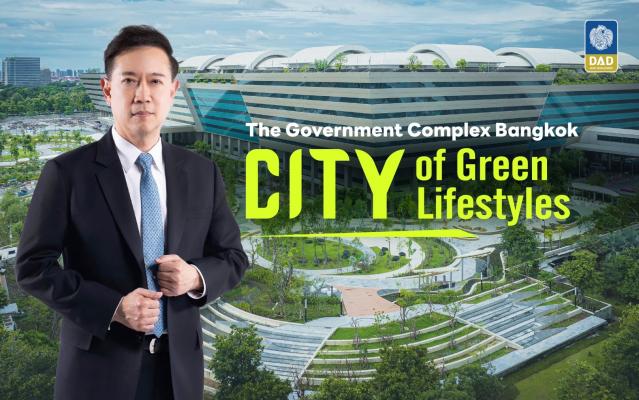
City of Green Lifestyles by Dr. Nalikatibhag Sangsnit
BANGKOK, THAILAND -
Media OutReach Newswire
- 23 December 2025 - Dhanarak Asset Development Co., Ltd. (DAD), the
state-owned enterprise responsible for managing Thailand's Government
Complex, has announced the successful transformation of the site into a
pioneering green and walkable urban prototype, positioning it as a model
for sustainable government-led city development.
Under the leadership of
Dr. Nalikatibhag Sangsnit, President of DAD, the multi-year
redevelopment program reimagines state-owned land, one that treats
public land not as a bureaucratic perimeter, but as
shared civic infrastructure that prioritizes people, health, and nature.
Dr. Nalikatibhag Sangsnit, DAD's President
"For decades, government districts in Thailand were designed to manage
paperwork, not people," Nalikatibhag said. "We wanted to reverse that
logic. A city, especially a city owned by the state, must first work for
human life: how people walk, how they rest, how they breathe, and how
they coexist with nature in their daily routines."
Before-and-after comparison of Government Complex Bangkok after its green redevelopment
From Bureaucratic Grey to Green Living
The centrepiece of the initiative is the newly opened
5.1-rai landscaped connector between Buildings B and C, a site
that once functioned primarily as a traffic corridor and noise buffer.
The area has been transformed into a pedestrian-friendly green passage
linking offices, transit access points and communal spaces within the
Government Complex.
Designed as
urban infrastructure, a climate buffer reduces heat, improves
water absorption and supports daily movement across the site. It also
opens previously restricted government land to wider public use,
blurring the boundary between administrative space and the city around
it.
The project aligns with Thailand's broader sustainability frameworks,
including environmental, social and governance (ESG) principles and the
government's bio-circular-green (BCG) economic model. Design features
focus on expanding tree canopy, increasing permeable surfaces and
creating flexible areas that can support exercise, informal gatherings
and community activity.
A Scalable Blueprint for State-Led Urban Transformation
Over the past six years, DAD has increased green spaces within the Government Complex by more than
47 rai, and when combined with adjacent landscaped zones, the total reaches
over 138 rai, creating one of northern Bangkok's largest continuous public green areas.
Nalikatibhag describes the
City of Green Lifestyles concept not as a one-off redevelopment, but as a
template for future public-sector land use, particularly in rapidly urbanising Asian cities where governments remain among the largest landowners.
"This is about proving that sustainability is not an added cost or a
branding exercise," he said. "When green infrastructure is designed as
part of the system, when it improves health, reduces stress, lowers
energy demand and invites public use, it becomes economically rational
and socially inevitable. The role of the state is not only to regulate
cities, but to set an example of how cities should be lived in."
Global Recognition for Innovation
DAD's sustainability efforts have earned international acclaim. In
2025, the company became the
only public-sector organisation to win the
Asia-level International Innovation Awards for two consecutive years, recognising its
Government Complex Smart City initiative and the
GCC Super Application, a digital platform integrating transport, navigation, and public services within the complex.
The awards, selected from more than 160 entries across 30 countries,
underscore Thailand's growing leadership in sustainable and
technology-driven public sector transformation.
Redefining the Role of the State in City-Making
Unlike large-scale urban megaprojects, the Government Complex Bangkok initiative relies on
system-based, incremental transformation, repurposing existing
assets instead of acquiring new land. Urban policy analysts note that
this approach provides a scalable blueprint for other governments
managing extensive real estate portfolios.
"A government city should not feel separate from everyday life," Dr.
Nalikatibhag said. "If public space eases the intensity of daily life,
improves health and restores a sense of balance between people and
nature, then governance itself becomes more humane."




 https://www.dad.co.th
 https://www.facebook.com/DhanarakAssetDevelopment/









 Sabtu, 20 Desember 2025 | 19:40

 Kamis, 18 Desember 2025 | 17:38
 Kamis, 18 Desember 2025 | 09:47