Menu Website

- Home
- MediaOutReach
- OceanX Completes Landmark Timor-Leste Expedition, Delivering One of the Region's Most Comprehensive Marine Surveys

OceanX Completes Landmark Timor-Leste Expedition, Delivering One of the Region's Most Comprehensive Marine Surveys
Selasa, 02 Desember 2025 | 21:46
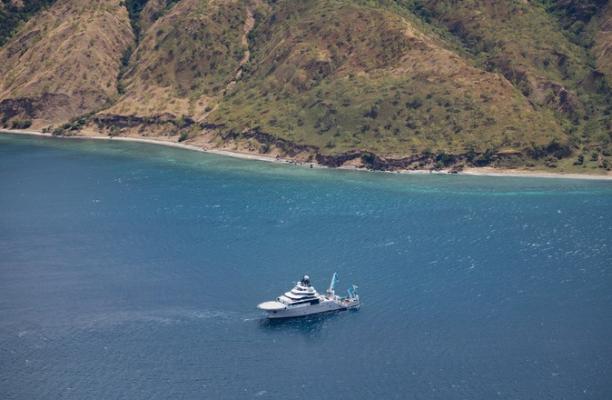
Against the backdrop of Atauro Island, OceanXplorer leads a landmark mission in Timor-Leste, mapping blue whale migrations and rich reef habitats to build a new scientific baseline for ocean protection.
Dili, Timor-Leste -
Media OutReach Newswire
- 2 December 2025 - The mission brought together scientists from KAUST,
the University of Florida, the University of Western Australia, and
Timorese counterparts to investigate biodiversity, whale ecology, and
seafloor structure in one of the most dynamic marine corridors of the
Coral Triangle.
The Prime Minister of the Democratic Republic of Timor-Leste, His Excellency Kay Rala Xanana Gusmão, said "The Government of Timor-Leste was pleased to partner with OceanX on this historic expedition in our waters. The research has revealed the extraordinary richness of our marine biodiversity and provided some of the most valuable and comprehensive scientific data our country has ever had, covering coral reefs, deep-sea ecosystems and the annual blue whale migration. These findings give us a strong foundation for future conservation, including the establishment of a national park around Atauro Island."
Vincent Pieribone, Co-CEO and Chief Scientist of OceanX, said the mission marked a major step in understanding the Timor Passage. "This region holds an exceptional range of species and habitats, and our teams were able to document it with a depth and breadth that has rarely been possible in these waters. The volume of information collected across deep, midwater, and coastal environments will support research for years to come."
Building a New Baseline for Timor-Leste's Ocean Science
Over fourteen operational days, researchers mapped close to five thousand square kilometers of seabed and recorded more than one hundred hours of sustained ROV and submersible activity. These dives generated extensive samples and imagery from steep slopes, midwater zones, and deep benthic habitats that have remained largely unexplored.
The expedition also delivered a detailed view of the seasonal blue whale migration. Helicopter teams, drones, and small vessels enabled sixty blue whale sightings and nearly fifty individual encounters, which produced a strong set of genetic and microbiome samples. These records will strengthen ongoing work to understand whale health and the impact of cookie-cutter shark interactions along the migration corridor north of Dili.
Andrew Craig, the mission lead for OceanX, highlighted the coordinated effort required to achieve this. "Every part of the ship contributed to this result. Deep-sea systems, mapping crews, aerial teams, and whale researchers worked in constant collaboration. The scale of the dataset reflects the commitment of the team and the strong support we received in Timor-Leste."
A Comprehensive Biodiversity Record
The mission's bioblitz program added substantial depth to the scientific output. Scientists collected more than four thousand biological samples, including corals, invertebrates, and cryptic species from reef, mesophotic, and bathyal environments. Early assessments indicate representation from roughly two thousand species. These findings reinforce the global significance of the Timor Passage and strengthen the scientific foundation for long-term monitoring.
High-resolution bathymetry gathered during the mission will contribute to global mapping initiatives and help fill major knowledge gaps in the region's seafloor structure. These datasets, combined with biological and megafauna records, will support collaborative research and advance efforts to understand ecosystem connections across the Indo-Pacific.
Towards Long-Term Impact
The Timor-Leste expedition delivers a major contribution to regional marine science. The data collected will support biodiversity assessments, whale ecology research, and the development of long-term baselines for the Atauro Marine Protected Area. It also strengthens OceanX's collaboration with Timorese institutions, creating new opportunities for research, education, and capacity building.
The Prime Minister of the Democratic Republic of Timor-Leste, His Excellency Kay Rala Xanana Gusmão, said "The Government of Timor-Leste was pleased to partner with OceanX on this historic expedition in our waters. The research has revealed the extraordinary richness of our marine biodiversity and provided some of the most valuable and comprehensive scientific data our country has ever had, covering coral reefs, deep-sea ecosystems and the annual blue whale migration. These findings give us a strong foundation for future conservation, including the establishment of a national park around Atauro Island."
Vincent Pieribone, Co-CEO and Chief Scientist of OceanX, said the mission marked a major step in understanding the Timor Passage. "This region holds an exceptional range of species and habitats, and our teams were able to document it with a depth and breadth that has rarely been possible in these waters. The volume of information collected across deep, midwater, and coastal environments will support research for years to come."
Building a New Baseline for Timor-Leste's Ocean Science
Over fourteen operational days, researchers mapped close to five thousand square kilometers of seabed and recorded more than one hundred hours of sustained ROV and submersible activity. These dives generated extensive samples and imagery from steep slopes, midwater zones, and deep benthic habitats that have remained largely unexplored.
The expedition also delivered a detailed view of the seasonal blue whale migration. Helicopter teams, drones, and small vessels enabled sixty blue whale sightings and nearly fifty individual encounters, which produced a strong set of genetic and microbiome samples. These records will strengthen ongoing work to understand whale health and the impact of cookie-cutter shark interactions along the migration corridor north of Dili.
Andrew Craig, the mission lead for OceanX, highlighted the coordinated effort required to achieve this. "Every part of the ship contributed to this result. Deep-sea systems, mapping crews, aerial teams, and whale researchers worked in constant collaboration. The scale of the dataset reflects the commitment of the team and the strong support we received in Timor-Leste."
A Comprehensive Biodiversity Record
The mission's bioblitz program added substantial depth to the scientific output. Scientists collected more than four thousand biological samples, including corals, invertebrates, and cryptic species from reef, mesophotic, and bathyal environments. Early assessments indicate representation from roughly two thousand species. These findings reinforce the global significance of the Timor Passage and strengthen the scientific foundation for long-term monitoring.
High-resolution bathymetry gathered during the mission will contribute to global mapping initiatives and help fill major knowledge gaps in the region's seafloor structure. These datasets, combined with biological and megafauna records, will support collaborative research and advance efforts to understand ecosystem connections across the Indo-Pacific.
Towards Long-Term Impact
The Timor-Leste expedition delivers a major contribution to regional marine science. The data collected will support biodiversity assessments, whale ecology research, and the development of long-term baselines for the Atauro Marine Protected Area. It also strengthens OceanX's collaboration with Timorese institutions, creating new opportunities for research, education, and capacity building.
BERITA LAINNYA

Rabu, 03 Desember 2025 | 08:48
Rabu, 03 Desember 2025 | 08:48

Rabu, 03 Desember 2025 | 08:47

Rabu, 03 Desember 2025 | 08:46

Rabu, 03 Desember 2025 | 08:45

Rabu, 03 Desember 2025 | 08:45
Selasa, 02 Desember 2025 | 21:58

Selasa, 02 Desember 2025 | 21:57

Selasa, 02 Desember 2025 | 21:56

Selasa, 02 Desember 2025 | 21:51

Selasa, 02 Desember 2025 | 21:50

Selasa, 02 Desember 2025 | 21:48

BERIKAN KOMENTAR


-
Rabu, 03 Desember 2025 | 08:48
Greenbriar Announces Commencement of the Loan Closing Process for the USD $40 Million Sage Ranch Construction Facility
-
Rabu, 03 Desember 2025 | 08:48
Allianz Commercial: Geopolitics and cyber drive risk exposures for directors and officers in 2026
-
Rabu, 03 Desember 2025 | 08:47
Not All Degrees Are Equal: SIM Highlights the Power of Accreditation as Career Insurance
-
Rabu, 03 Desember 2025 | 08:46
Hong Kong: Independent committee to conduct comprehensive and in-depth review following major fire
-
-
Rabu, 03 Desember 2025 | 08:45
Africa Finance Corporation Raises Record US$524m in Dual-Currency Samurai Loan Facility

-
 Minggu, 30 November 2025 | 11:32
Terbaru, Kabar Link Video CCTV Inara Rusli yang Jadi Buruan Netizen
-
 Minggu, 30 November 2025 | 14:12
Inara Rusli Video 2 Jam Link Download Jadi Kata Kunci yang Sering Dicari Netizen
-
 Senin, 01 Desember 2025 | 09:07
Hasrizal Gerah: Banyak Anggota Dewan Mangkir, Gaji Puluhan Juta Tak Sejalan dengan Kinerja
-
 Rabu, 26 November 2025 | 09:06
Kontroversi Pulau Ancak, Aktivis Lingkungan di Dumai Desak GM Pelindo Buktikan dengan Data dan Surat dari Negara
-
 Jumat, 28 November 2025 | 08:59
Aruk Ingin GM Pelindo Tunjukan Bukti Surat dari Negara Terkait Reklamasi Pulau Ancak
-
 Kamis, 27 November 2025 | 09:48
Misteri Pulau Ancak yang Hilang, Warga Desak GM PT Pelindo Dumai Tunjukkan Bukti Surat dari Negara