Buffalo Potash Announces Preliminary Economic Assessment for Disley Project with After-Tax NPV of US$1.1B and IRR of 30%; Releases Results from Maiden 43-101 Mineral Resource Estimate
Buffalo Potash Announces Preliminary Economic Assessment for Disley Project with After-Tax NPV of US$1.1B and IRR of 30%; Releases Results from Maiden 43-101 Mineral Resource Estimate
Selasa, 28 April 2026 | 07:53
Saskatoon, Saskatchewan -
Newsfile Corp. - April 27, 2026 -
Buffalo Potash Corporation(TSXV: BUFF) (OTCQB: BLPTF) (the "Company" or "Buffalo") is pleased to announce the completion of a Preliminary Economic Assessment ("PEA") and concurrent release of its maiden 43-101 Mineral Resource Estimate for its 100%-owned Disley Potash Project (the "Disley Project"), located in Saskatchewan, Canada.
The PEA has been filed and can be found under the Company's profile on SEDAR+ (www.sedarplus.ca) and on the Company's website (www.buffalopotash.ca).
PEA & Mineral Resource Estimate Highlights
- Total production of 1,000,000 tonnes per annum (TPA) of K62
granular-grade Muriate of Potash (MOP) and 125,000 TPA of K62 soluble
grade MOP
- After-tax NPV(1)(8) of US$1.1B and IRR(1) of 30%
- US$639M initial CAPEX estimate, including US$128M in contingency
- Estimated US$55/t MOP OPEX (Table 4)
- Measured and indicated tonnage of 1,671.5 million metric tonnes at
an average grade of 34.8% KCl, yielding 582 million tonnes of KCl
- Over 50 years of mine life at 1,125,000 TPA based on current resource estimate (Table 2)(2)
- The advancement of a Feasibility Study ("FS") for Disley East and Disley West (the "HLD Mines") will run concurrent with Initial Production Module ("IPM")
construction, with FS completion representing the key decision gate for
proceeding to construction of Disley East and Disley West(3)
(2) Based on Measured and Indicated resource estimate of 582Mt at 34.8% KCl.
(3) The PEA does not constitute a feasibility study and does not demonstrate economic viability
Mr. Steve Halabura P.Geo., Buffalo Chief Executive Officer, commented:
"Since founding Buffalo Potash in 2018, the team and I have invested
years of disciplined work — geological, technical, and strategic — to
systematically unlock the potential of modular selective solution potash
mining in Saskatchewan, the key being Buffalo's Disley Project. Having
spent my career working in Saskatchewan potash, I had a strong
conviction from the beginning that Disley had a substantial resource
endowment, and this Mineral Resource Estimate confirms exactly that. The
PEA illustrates both low capex per tonne and operating cost per tonne,
as well as setting a new environmental standard for how potash
production should look in the 21st century — no tailings stored on surface and minimal freshwater usage."
Mr. Halabura continued: "The team and I believe the Disley
Project represents the next generation of Saskatchewan potash solution
mining and are excited to begin development of the Initial Production
Module, which will be the first leg of this buildout and is expected to
bring soluble-grade potash production online within the next 12 months.
During the development of the Initial Production Module, we will also
test our patent-pending Vortex Crystallizer, alongside an industry
standard crystallizer, which has the potential to significantly reduce
the capex of the Initial Production Module and further potential
build-outs. With global attention turning to the security of critical
supply chains, the urgency to bring reliable, jurisdiction-stable potash
production online has never been greater. This is a proud moment for
our team, our shareholders, and the stakeholders that have supported us
along the way — and we are just getting started."
Table 1: PEA Summary
Line Item
Units
Total Project
Production Rate MOP
TPA
1,000,000
Production Rate Soluble Grade
TPA
125,000
Total Initial CAPEX
US$ million
639
CAPEX per Tonne Capacity
US$/tonne
568
Average Unit OPEX
US$/tonne
55
MOP Price (25-year avg.)
US$/tonne
393.6(4)
Soluble Grade Price (25-year avg.)
US$/tonne
373.6(5)
Pre-Tax NPV(1) (8%)
US$ million
1,534.67
Pre-Tax IRR(1)
%
35
Post-Tax NPV(1) (8%)
US$ million
1,085.47
Post-Tax IRR(1)
%
30
Steady-State Annual Revenue
US$ million
442.5
Steady-State Annual EBITDA
US$ million
251.0
(4) LoM average price of Granular MOP, produced by Disley East and Disley West
(5) LoM average price of Soluble Grade MOP, produced by IPM
The PEA is preliminary in nature and includes inferred mineral
resources, which are considered too speculative geologically to have the
economic considerations applied to them that would enable them to be
categorized as mineral reserves. There is no certainty that the PEA will
be realized.
PEA & Mineral Resource Estimate Overview
The PEA was prepared by Micon International Co Limited ("Micon") in accordance with National Instrument 43-101
Standards of Disclosure for Mineral Projects and evaluates the
development of the Disley Project as a phased potash solution mining
operation. The PEA has an effective date of April 15, 2026 and is based
on a Mineral Resource Estimate ("MRE") developed concurrently by
Micon with an effective date of April 15, 2026, incorporating historical
assay data from legacy drilling programs as well as results from
Buffalo Potash's 2026 confirmation drill program. The PEA contemplates a
phased development approach across three production facilities on the
Disley property:
The Initial Production Module ("IPM") - is a low-capital entry point designed to bring 125,000 tonnes per year of soluble grade MOP to market;
Disley East - a full-scale HLD Mine on the east segment of
the Disley Project, with a production capacity of 500,000 tonnes per
year of granular MOP; and
Disley West - a full-scale HLD Mine on the west segment of
the Disley Project, with a production capacity of 500,000 tonnes per
year of granular MOP.
Successful construction of the IPM is anticipated to provide technical
data used in the completion of the concurrent FS and would, subject to
the results from the FS and a positive construction decision, be
followed by the potential concurrent development of the Disley East and
Disley West HLD solution mines. If fully developed, the Disley Project
is designed to have the capacity to produce 1,000,000 TPA of granular
MOP and 125,000 TPA of soluble grade MOP ("Full Production Capacity").
The MRE indicates a resource base that substantially exceeds the
project's current design requirements, which, if successfully developed,
would position the Disley Project as a long-life asset. This is
consistent with the generational mine lifecycles typically associated
with Saskatchewan potash operations, though there is no certainty that
resources will be converted to reserves or that any particular mine life
will be achieved.
Table 2: Mineral Resource Estimate
Category
Tonnage (Mt)
Avg KCl Grade
Avg K2O Grade
KCl (Mt)
K2O (Mt)
Measured
399.7
34.82%
22.00%
139.2
87.9
Indicated
1,267.4
34.84%
22.01%
441.5
278.9
Inferred
2,663.2
34.96%
22.08%
930.9
588.1
Table 2 Notes:
The effective date of this MRE is April 15, 2026.
Dr. Ryan Langdon, Ph.D, CGeol, of Micon is the QP responsible for this MRE.
The MRE has been classified in the Measured, Indicated and Inferred categories.
An average specific gravity (SG) value of 2.08 g/cm3 was used.
Conversion between KCl and K2O was made using the formula KCl = K2O * 1.583
The MRE used economic assumptions for HLD mining. A deduction was
made to account for the presence of mining anomalies not detected by
existing drill holes and seismic lines. The values used are 5% for
Measured, 9% for Indicated and 25% for Inferred.
The block model supporting the resource is orthogonal and has a block size of 50 m x 50 m x 0.9 m.
The mineral resources described above have been prepared in
accordance with the current Canadian Institute of Mining, Metallurgy and
Petroleum Standards and Practices.
Numbers have been rounded to the nearest million tonnes. Differences may occur in totals due to rounding.
Mineral Resources are not Mineral Reserves as they do not have
demonstrated economic viability. The quantity and grade of reported
Inferred Mineral Resources are uncertain in nature and there has been
insufficient exploration; however, it is reasonably expected that a
significant portion of Inferred Mineral Resources could be upgraded into
Indicated Mineral Resources with further exploration.
Micon's QP has not identified any legal, political, environmental,
or other factors that could materially affect the potential development
of the mineral resource estimate.
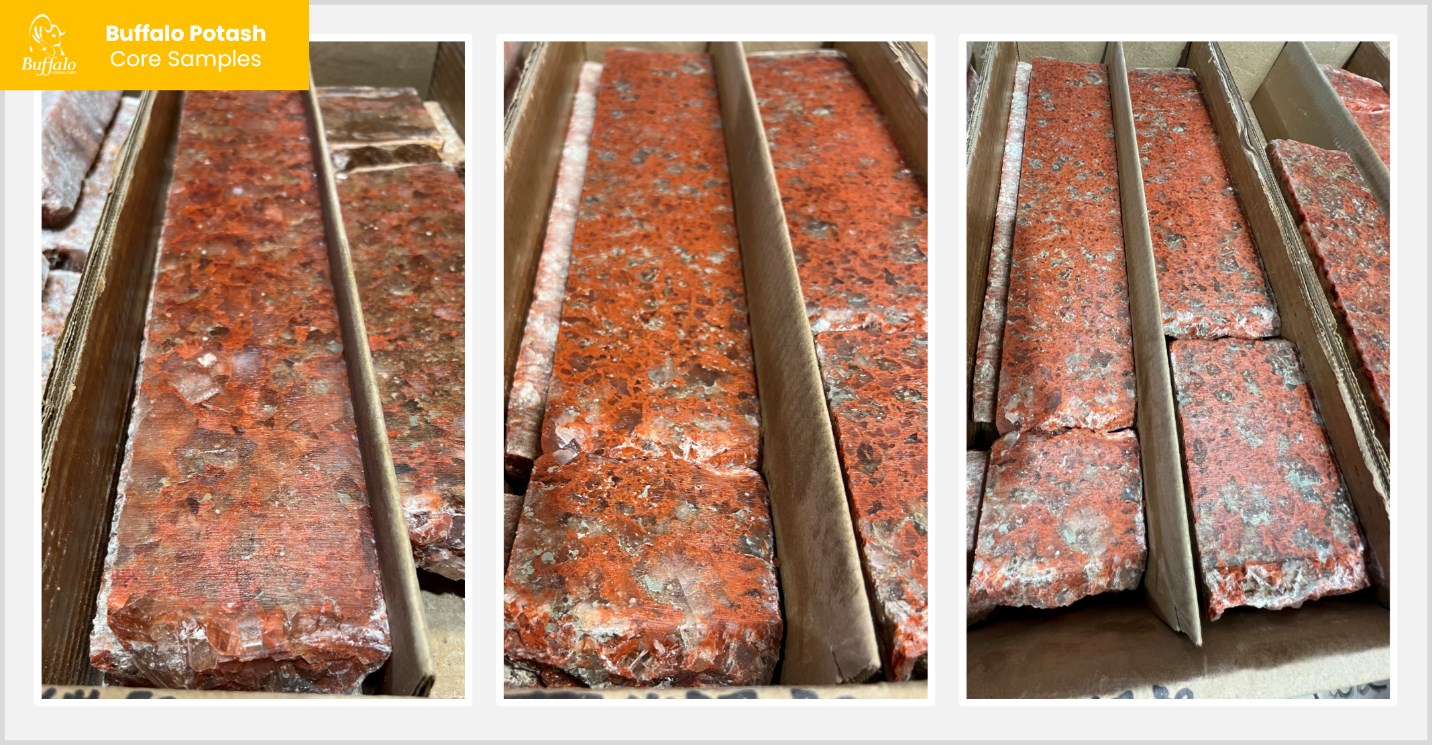
Figure 1: Core Samples from the 7-10 Hole on the Disley Project
Buffalo intends to develop the Project using solution mining, a
well-established approach that has been successfully deployed across
Saskatchewan for more than 50 years. Solution mining is widely
recognized as a reliable and efficient technique for extracting potash
from laterally continuous deposits, notably used at both neighboring
properties of the Disley Project — the K+S Bethune mine and the Mosaic
Belle Plaine mine.
Building on this proven foundation, Buffalo holds a patent on an
enhanced solution mining approach known as Horizontal-Line-Drive
Selective Solution Mining ("HLD Mining"), which is the
installation of commercially proven oil and gas injection systems within
horizontal wells. This method is designed to optimize efficiency,
reduce overall capital intensity, and significantly limit freshwater
requirements, while remaining grounded in the principles of traditional
solution mining.
Following underground dissolution, potash-rich brine is recovered to
surface and processed through crystallization, drying, and compaction to
produce a finished potash product ready for local delivery or export
via existing road and rail infrastructure that currently runs adjacent
to the Disley Property.
Initial Capital Expenditure (CAPEX)
The initial capital cost estimate has been prepared in line with the
Class 4 definition outlined by AACE International standards, with a
contingency of 25% applied to the IPM, Disley East, and Disley West
components.
Mechanical equipment represents the largest component of initial capital
expenditure at approximately 38% of Total Project initial CAPEX. For
Disley East and Disley West, the mechanical scope encompasses the full
processing train required to produce export-grade granular MOP,
including crystallization, debrining and drying, compaction and glazing,
soluble product screening, and product storage and loading. For the
IPM, the mechanical scope includes a crystallizer, pumps, tanks,
pipework, centrifuge, dryer, and baghouse. Total initial capital
expenditure across all three facilities is US$639 million, as summarized
in the table below.
Table 3: Initial CAPEX Summary
Description
IPM
Disley East
Disley West
Total Project
(US$ million)
(US$ million)
(US$ million)
(US$ million)
Site Works
0.7
11.3
11.3
23.3
Concrete
-
5.6
5.6
11.2
Structural Steel
1.2
9.3
9.3
19.9
Mechanical
15.1
113.3
113.3
241.7
Piping
0.2
14.9
14.9
30.0
Electrical
-
15.0
15.0
29.9
Instrumentation
0.1
2.9
2.9
5.9
Architecture
0.0
19.6
19.6
39.2
Minor Mechanical
4.7
2.4
2.4
9.4
General Construction
1.4
13.3
13.3
28.0
Indirects
-
36.1
36.1
72.3
Contingency
5.8
60.9
60.9
127.7
Total Capital Expenditure(6)
29.2
304.7
304.7
638.6
(6) For modelling purposes, the total capital expenditure
estimate for the PEA assumes use of an industry standard crystallizer
instead of Buffalo's patent-pending Vortex Crystallizer.
Sustaining capital of US$483 million (US$17/t MOP) over the life of mine
comprises an annual provision of 2% of original fixed plant and surface
infrastructure costs, plus US$10/t MOP for the drilling, completion and
tie-in of replacement wells — the dominant component of sustaining
capital — based on each set of three wells yielding 500,000 tonnes over
an approximate 5-year useful life.
Operating Expenses (OPEX)
Buffalo Potash's estimated operating cost of US$55/t MOP reflects the
structural advantages of operating in Saskatchewan, a mature potash
jurisdiction with competitive industrial energy rates, an established
skilled workforce, and existing road and rail infrastructure adjacent to
the Disley Property enabling low-cost delivery to both domestic and
export markets. Buffalo management anticipates these fundamentals
position the Disley Project to be among the lowest-cost potash producers
upon reaching full production.
Table 4: OPEX Summary
Item
Description
1,125,000 TPA
(US$ million)
IPM Contingency
$14.49/t applied to IPM production only
1.8
Wellfield Power
500 Hp at $0.063/kWh
1.8
Processing Power
19,356 Hp at $0.063/kWh
18.0
Drilling
$25,000/day; 45 days/yr
0.1
Pipes, Pumps, Valves
Steaming & general maintenance
0.8
Instrumentation
Monitoring & controls
0.4
Labour
32 staff
7.8
Natural Gas
$386/1000m³ incl. carbon tax
19.6
Maintenance
5% of major equipment capital
5.4
Reagents
Dedust oil & anticake amines
2.0
Water
$2.20/m³; 45 m³/hr
1.3
General & Admin Supervision
Management & safety
1.9
Admin Supplies
Office & admin supplies
0.8
Total Annual OPEX
61.7
OPEX US$/t MOP
55 / tonne
Economic Assumptions
The economic analysis evaluates the Disley Project as a phased
development consisting of the IPM to establish early cash flow, followed
by the full-scale HLD Mine comprising Disley West and Disley East. The
IPM was evaluated as a standalone project, with the HLD Mine (Disley
East and Disley West) assessed on an incremental basis and in
combination with the IPM as an overall project. A Discounted Cash Flow
("DCF") model was constructed with the following assumptions:
All costs and revenues are expressed in constant, first quarter 2026
money terms, with no provision for escalation or inflation;
Capital and operating cost estimates denominated in Canadian dollars
have been converted to US dollars at an exchange rate of CAD 1.38 per
USD;
A discount rate of 8% has been applied on an all-equity basis;
The pre-tax results presented include the Saskatchewan Potash
Production Tax (PPT) and royalties but exclude federal and provincial
corporate income tax. The after-tax results include corporate income tax
(Saskatchewan 12%, Federal 15%);
The IPM ramps up over 3 months at 50% of nominal capacity; Disley
West and Disley East have a 6-month ramp-up period at 50% of capacity,
with the Disley East being deferred by a 3-month offset from the West
Section;
It is assumed the IPM is scheduled to begin construction July 2026 with commercial operations starting January 2027;
It is assumed that a positive construction decision will be reached
on Disley West and Disley East. Disley West is scheduled to begin
construction July 2027, with operations beginning July 2029.
Construction at Disley East is scheduled to be the final facility
developed, with construction beginning October 2027 and operations
beginning October 2029;
Soluble grade MOP produced by the IPM is sold locally, incurring a
transport cost of US$10/t compared to US$43/t for export grade granular
MOP railed FOB Vancouver; soluble grade MOP is priced at a US$20/t
discount to granular, reflecting a life-of-mine average of US$373.6/t
versus US$393.6/t FOB Vancouver;
In addition to MOP, the IPM will produce 50,000 m³ per year of KCl
brine that may be attractive to regional oilfield services customers at
an average transport cost of US$10/m³;
Payback period is measured from the start of construction to the point at which cumulative cash flow turns positive; and
Although the project's mine life is anticipated to extend beyond a 25-year time frame, the NPV(1) and IRR(1) calculations reflect a 25-year "LoM" period.
The primary input parameters for the DCF model are outlined in the table below.
Table 5: Summary of Inputs for Economic Analysis
Input Parameters
Unit
Value
Evaluation Base Date - IPM
Date
2026-07-01
Evaluation Base Date - Disley East & Disley West
Date
2027-07-01
Sales: HLD Mine MOP Sales (granular)
TPA
1,000,000
Sales: IPM MOP (soluble)
TPA
125,000
Sales: KCl Brine
m3/yr
50,000
Price: Granular MOP (FOB Vancouver) 25-year average
US$/t
394
Price: Soluble MOP 25-year average
US$/t
374
Price: KCl Brine
US$/m3
43
Transport Costs: Granular MOP
US$/t
43
Transport Costs: Soluble MOP
US$/t
10
Transport Costs: KCl Brine
US$/m3
10
Corporate Tax (Sask. + Canada)
%
27%
Contingency for CAPEX
%
25%
Discount Rate
%
8%
NPV calculation
Years
25
The Disley East and Disley West mines have a start date of construction
later than that of the Initial Production Module, and their IRR(1), NPV(1)
and Payback periods are all calculated from that later date, while the
overall Project results reflect the start date of the IPM. The
individual IPM phase has a payback period of 1.1 years, while Disley
East and Disley West each respectively have payback periods of 2.9
years. The total Project payback of 4.7 years reflects an earlier
calculated start date at the time of first production at the IPM, prior
to first production from Disley East and Disley West.
Table 6: Summary of Outputs
Metric
Unit
Total Project
Initial CAPEX
US$ million
639
OPEX
US$
55 / tonne
Pre-Tax NPV(1) (8)
US$ million
1,534
Pre-Tax IRR(1)
%
35%
Post-Tax NPV(1) (8)
US$ million
1,085
Post-Tax IRR(1)
%
30%
The Disley Project
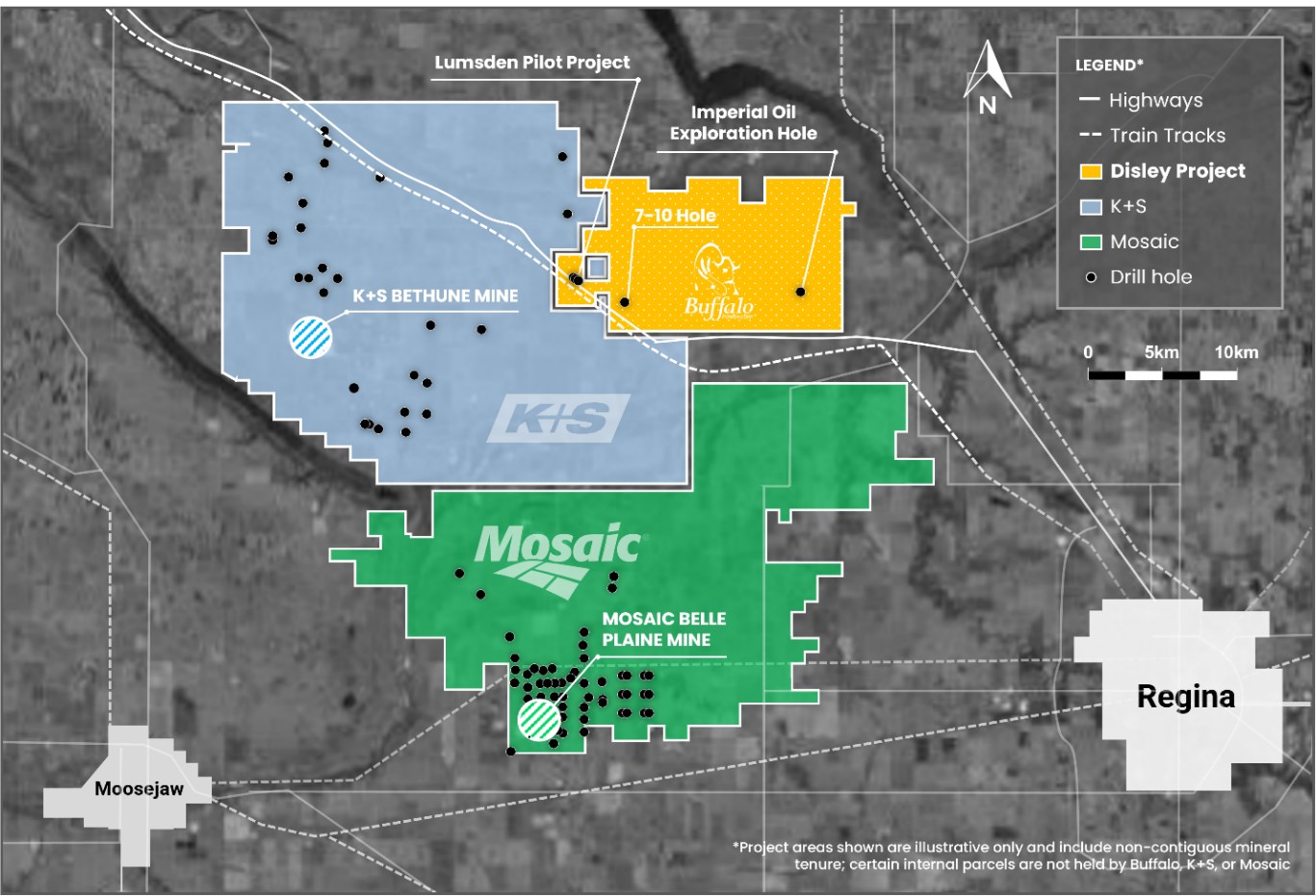
The Disley Project is located approximately 50km northwest of Regina and
covers 10,610 hectares (Crown and Freehold mineral rights). The
property is situated immediately adjacent to the east of the K+S Bethune
potash solution mine and north of the Mosaic Belle Plaine potash
solution mine — both of which are amongst the largest producing potash
solution mines in the world. In the opinion of management, the Disley
Project is in one of the most favorable areas of Saskatchewan for potash
solution mining (see Figure 2) as evidenced by the success of these
neighboring projects(6).
Figure 2: The Disley Property Situated Amongst Major Potash Solution Mines(7)
Buffalo Potash is an emerging Saskatchewan-based potash developer
pursuing a modular approach to selective solution mining through its
patented Horizontal Line-Drive (HLD) technology. Buffalo is advancing
the Disley Project — located next to several of the most prominent
currently producing potash solution mines in the world — with the
objective of establishing capital-efficient, lower-impact potash
production in one of the world's leading potash jurisdictions.
Qualified Person
The scientific and technical information contained in this news release
has been reviewed and approved by Douglas F. Hambley, PhD, PE, P.Eng.,
PG, an independent consultant of the Company and Qualified Person as
defined under NI 43-101 Guidelines. Dr. Hambley is a globally recognized
expert in potash geology and mine development and has assisted Micon in
their preparation of the MRE and PEA.
All related and pertinent information has also been reviewed for this
news release by Jared Galenzoski, P.Geo, FIMMM as an independent
consultant and Qualified Person as defined under NI 43-101. Mr.
Galenzoski is also an expert in several potash-related fields and has
assisted Micon in their preparation of the MRE and PEA.
Technical Report and Qualified Persons
For more information in respect of the Disley Project, including with
respect to key assumptions, parameters, and methods used to estimate the
MRE, data validation and QA/QC procedures, and the basis,
qualifications and assumptions for the PEA, please refer to the entirety
of the Technical Report prepared by Ryan Langdon, PhD, P.Geol.; Jack
Nagy, PEng; Christopher Jacobs, CEng., MIMMM; and Richard Thompson,
CEng, MiChemE. Each of the aforementioned persons is considered a
"Qualified Person" for the purposes of NI 43-101 and has reviewed and
approved the scientific and technical disclosure contained in this news
release. No limitations were imposed on their verification process.
Readers are cautioned to review the entirety of the PEA as it contains
additional disclosures material to the matters discussed in this press
release.
Notes (7) The K+S Bethune potash solution mine and north of the Mosaic Belle Plaine potash solution mine (together, the "Adjacent Properties")
may each be considered an "adjacent property" (within the meaning of NI
43-101) to the Company's Disley Project. The Company does not have any
interest in either of the Adjacent Properties. The Company believes this
context is useful in illustrating the proven endowment of the district,
while noting that mineralization on adjacent or nearby properties is
not indicative of mineralization on the Company's Disley Project. There
is no guarantee that the Disley Project will yield comparable results to
any of these mines.
Contact
Steve Halabura, P.Geo. | Chief Executive Officer & Director
Email:
steve@buffalopotash.ca | Phone: 1-306-220-7715
(1) Non-GAAP Financial Measures
Net Present Value ("NPV") and internal rate of return ("IRR")
are forward-looking financial measures used by management to evaluate
the economic potential of the Disley Project, as estimated in the PEA.
These measures do not have standardized definitions under IFRS and may
not be comparable to similar measures disclosed by other issuers.
NPV represents the sum of discounted future after-tax cash flows
projected over the 25-year evaluation period at a discount rate of 8%,
net of initial and sustaining capital expenditures. The most comparable
IFRS measure is net income (loss); however, NPV is a forward-looking
measure that reflects projected future cash flows and cannot be directly
reconciled to historical net income. IRR represents the discount rate
at which NPV equals zero across the project's projected cash flows.
These measures should not be construed as alternatives to net income,
comprehensive income, or cash flows from operations as determined in
accordance with IFRS. Readers are cautioned that these measures reflect
PEA-level estimates and are subject to the risks and uncertainties
disclosed under "Forward-Looking Information" below.

















 Selasa, 28 April 2026 | 09:16
 Selasa, 28 April 2026 | 09:15
 Selasa, 28 April 2026 | 09:13
 Selasa, 28 April 2026 | 09:12
 Jumat, 17 April 2026 | 12:23

 Jumat, 24 April 2026 | 10:16