Menu Website

- Home
- MediaOutReach
- Save the Children Hong Kong's Play to Thrive: Prioritising Personal Growth Over Competitive Success

Save the Children Hong Kong's Play to Thrive: Prioritising Personal Growth Over Competitive Success
Selasa, 30 Juni 2026 | 20:51
HONG KONG SAR -
Media OutReach Newswire
- 30 June 2026 - The four-yearly World Cup is in full swing, and the
football fever once again sweeps the globe. The pitch has long been
known as a "proving ground" for heroes; even for world-class players
with years of experience, the joy of scoring a goal is often balanced by
the sight of others in tears, frustrated by a defeat. The prowess of
these players will be etched into the hearts of countless children,
inspiring a lifelong love for the sport.
Save the Children Hong Kong firmly believes that the football pitch is more than just a venue for competition—it is an ideal classroom for Social-emotional Learning. For eight-year-old Kai-long, the setbacks and failures experienced on the pitch have proven far more vital to his personal growth than mastering technical skills or perfecting "step-overs".
The Play to Thrive programme empowers children to master emotional management and communication skills while staying active in sports. Compared to a "Zidane turn", these are the skills that will truly serve them for a lifetime.
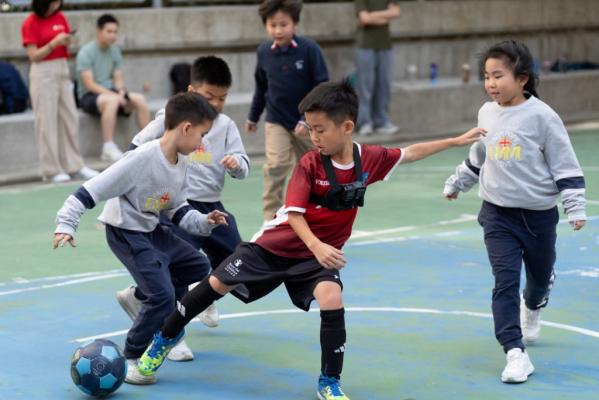
On the training ground, eight-year-old Kai-long's skills are clearly "a cut above the rest". From the way he carries the ball to the power of his strikes, he already carries himself like a mini professional. During internal matches, he frequently finds the back of the net, scoring multiple goals for his side.
However, the moments that truly bring a smile of approval to the coaches and teachers are not Kai-long's technical displays, but his small yet heart-warming gestures. For instance, he is seen helping teammates by steadying the inflatable goalposts during shooting drills. Even when knocked down during a match, if the coach does not blow for a foul, Kai-long doesn't complain; he simply brushes it off with a smile and gets straight back to chasing the ball.
When Excellence Becomes a Burden: Children Trapped by the Need to Win
"He has a personality that tends to be quite fixated on winning and losing. Because of his own performance, or because his classmates' performance didn't meet his expectations, he would sometimes experience emotional ups and downs," explains Mr. Lui, the PE teacher. He admits that while Kai-long's football skills are outstanding, his stubborn nature previously caused friction with teammates and classmates. Mr. Lui noted that since Kai-long was already a member of the school's reserve team, he recommended him for the Play to Thrive programme not to "learn football", but in the hope that he would learn how to get along with others.
Consequently, what moved Mr. Lui the most was not Kai-long's "goal-scoring show", but his reaction during a match when other students deliberately moved the inflatable goalposts. Instead of complaining or losing his temper as he might have done in the past, Kai-long continued to play with a smile on his face. "Previously, he might have called it unfair or had an emotional outburst, but today he didn't complain; he even found it quite funny. He is no longer fixated on winning or losing."
In the eyes of his father, Chung, Kai-long has been a child with extremely high expectations of himself and a drive for perfection since he was young. "Whether it is schoolwork or his behaviour, he hopes to be a good role model and be very well-behaved." However, Chung also mentioned that this perfectionist streak serves as a source of pressure for Kai-long.
Interpersonal Skills Are More Important Than Footballing Ability
Chung admits that Kai-long used to be very fixated on winning and losing: "In the past, if he lost a game of football against his elder brother, he would be resentful; when he was younger, he even tried to hit him." While it is natural to crave goals and seek victory on the pitch, Chung also believes that how one treats others and interacts with peers is a vital part of growing up, which is why he enrolled Kai-long in Play to Thrive.
"Football is a natural educational tool," says Ms. Wong Shek Hung, Director of Hong Kong Programmes at Save the Children Hong Kong. She explains that experiencing victory, defeat, and frustration is inevitable in sports, providing the perfect opportunity for children to learn emotional management. She adds that Play to Thrive originated from a community football programme developed by Save the Children UK for children in Jordan and Indonesia.
The core of the programme lies in integrating Social-emotional Learning into football training to help children build five core competencies: self-awareness, self-management, social awareness, relationship skills, and responsible decision-making. Furthermore, the programme is open to all children regardless of gender, ethnicity, or background, allowing them to master self-awareness, emotional regulation, and team communication skills within a diverse and inclusive environment.
No Ordinary Football Training
As this is unlike conventional football training, every coach is required to undergo professional training covering "Child Safeguarding" and emotional support knowledge. Ms. Wong Shek Hung notes that during the "debriefing" session at the end of each practice, coaches guide the children to reflect on their experiences on the pitch, attempting to translate these moments into emotional literacy. The ultimate goal is "to let children learn how to become 'masters of their own emotions'."
Demonstrating Personal Growth and Cultivating Leadership Skills
Mr. Lui noticed that after joining the programme, Kai-long not only showed progress in his personal emotional management but also learned how to consider things from others' perspectives. During PE lessons, Kai-long has become more willing to take the initiative to help his classmates and has learned to accept teammates with different abilities, even proactively coaching others. "He gets along with his classmates much more harmoniously now; the barriers that existed before have disappeared," Mr. Lui remarked. He further revealed that Kai-long's form teacher, having observed this growth, officially appointed him as a class monitor for the second term.
His father, Chung, observed that since joining the programme, Kai-long has demonstrated a level of resilience rarely seen before. He recalled a match where Kai-long served as both captain and goalkeeper; even when facing conceded goals and falling behind, "his first instinct wasn't to feel discouraged, but rather to keep encouraging his teammates from the back to keep running and keep attacking."
Ms. Wong Shek Hung reaffirmed that this is precisely the philosophy of Play to Thrive: "We emphasise 'Football Second, Growth First', ensuring that even if children lose a match, they learn to handle their emotions, communicate, and cooperate throughout the process."
Building Resilience: Transforming Lives Through Football
Ms. Kalina Tsang, CEO of Save the Children Hong Kong, stated that she has always believed football is a powerful tool for building resilience in children: "We have always been concerned about children's physical and mental well-being. Football is more than just a sport; beyond honing technical skills, it can be used to build a child's resilience. By combining football training with Social-emotional Learning, and under the guidance of professionally trained coaches, Play to Thrive ensures that the sweat shed by children on the pitch is transformed into self-awareness and emotional management skills." Ms. Tsang also noted that Kai-long's growth perfectly embodies the programme's success. She said, "We are deeply gratified to see Kai-long progress from initial emotional fluctuations to confidently cooperating with teammates and facing victory or defeat positively—improving both on a personal level and in his interactions with peers."
As for Kai-long himself, it is difficult for an eight-year-old to describe his transformation in detail. But when asked what was different about him, he said with an innocent smile, "I used to blame my teammates for not passing the ball, but now I've learned not to. I tell them: 'It's okay, pass it again next time. We'll win the ball back together.'"
Launched in Hong Kong in 2023, the Play to Thrive programme is a service that integrates Social-emotional Learning with football training. It aims to create a safe and supportive space for schoolchildren, promoting their physical, social, and mental health through sport. The programme currently operates across various districts in Hong Kong, including community teams in areas such as Sham Shui Po and Tin Shui Wai. The school-based project collaborates with over 30 primary schools across the territory, integrating football training into school life to help students recognise and manage their emotions, build healthy interpersonal relationships, and enhance their confidence and resilience. In response to the current situation where up to 39% of primary and secondary students in Hong Kong face mental health challenges, the programme places special emphasis on SEL to help children master effective communication and emotional management both on and off the pitch.
In 2025 alone, the community and school projects of Play to Thrive held a total of 744 training sessions, with total service hours exceeding 1,000 hours. The programme reached 1,120 children and their families across Hong Kong, establishing close partnerships with 32 schools and 4 non-profit organisations. In terms of impact assessment, participant satisfaction was high, with satisfaction rates for the community and school projects reaching 80% and 75%, respectively.
Interview Video: https://savethechildren.click/PTT-KaiLong-Video-2026
 https://savethechildren.org.hk/en/
 https://www.linkedin.com/company/save-the-children-hong-kong
 https://www.facebook.com/savethechildrenhk
 https://www.instagram.com/savethechildrenhk/
YouTube: https://www.youtube.com/user/savehk
Save the Children Hong Kong firmly believes that the football pitch is more than just a venue for competition—it is an ideal classroom for Social-emotional Learning. For eight-year-old Kai-long, the setbacks and failures experienced on the pitch have proven far more vital to his personal growth than mastering technical skills or perfecting "step-overs".
The Play to Thrive programme empowers children to master emotional management and communication skills while staying active in sports. Compared to a "Zidane turn", these are the skills that will truly serve them for a lifetime.
On the training ground, eight-year-old Kai-long's skills are clearly "a cut above the rest". From the way he carries the ball to the power of his strikes, he already carries himself like a mini professional. During internal matches, he frequently finds the back of the net, scoring multiple goals for his side.
However, the moments that truly bring a smile of approval to the coaches and teachers are not Kai-long's technical displays, but his small yet heart-warming gestures. For instance, he is seen helping teammates by steadying the inflatable goalposts during shooting drills. Even when knocked down during a match, if the coach does not blow for a foul, Kai-long doesn't complain; he simply brushes it off with a smile and gets straight back to chasing the ball.
When Excellence Becomes a Burden: Children Trapped by the Need to Win
"He has a personality that tends to be quite fixated on winning and losing. Because of his own performance, or because his classmates' performance didn't meet his expectations, he would sometimes experience emotional ups and downs," explains Mr. Lui, the PE teacher. He admits that while Kai-long's football skills are outstanding, his stubborn nature previously caused friction with teammates and classmates. Mr. Lui noted that since Kai-long was already a member of the school's reserve team, he recommended him for the Play to Thrive programme not to "learn football", but in the hope that he would learn how to get along with others.
Consequently, what moved Mr. Lui the most was not Kai-long's "goal-scoring show", but his reaction during a match when other students deliberately moved the inflatable goalposts. Instead of complaining or losing his temper as he might have done in the past, Kai-long continued to play with a smile on his face. "Previously, he might have called it unfair or had an emotional outburst, but today he didn't complain; he even found it quite funny. He is no longer fixated on winning or losing."
In the eyes of his father, Chung, Kai-long has been a child with extremely high expectations of himself and a drive for perfection since he was young. "Whether it is schoolwork or his behaviour, he hopes to be a good role model and be very well-behaved." However, Chung also mentioned that this perfectionist streak serves as a source of pressure for Kai-long.
Interpersonal Skills Are More Important Than Footballing Ability
Chung admits that Kai-long used to be very fixated on winning and losing: "In the past, if he lost a game of football against his elder brother, he would be resentful; when he was younger, he even tried to hit him." While it is natural to crave goals and seek victory on the pitch, Chung also believes that how one treats others and interacts with peers is a vital part of growing up, which is why he enrolled Kai-long in Play to Thrive.
"Football is a natural educational tool," says Ms. Wong Shek Hung, Director of Hong Kong Programmes at Save the Children Hong Kong. She explains that experiencing victory, defeat, and frustration is inevitable in sports, providing the perfect opportunity for children to learn emotional management. She adds that Play to Thrive originated from a community football programme developed by Save the Children UK for children in Jordan and Indonesia.
The core of the programme lies in integrating Social-emotional Learning into football training to help children build five core competencies: self-awareness, self-management, social awareness, relationship skills, and responsible decision-making. Furthermore, the programme is open to all children regardless of gender, ethnicity, or background, allowing them to master self-awareness, emotional regulation, and team communication skills within a diverse and inclusive environment.
No Ordinary Football Training
As this is unlike conventional football training, every coach is required to undergo professional training covering "Child Safeguarding" and emotional support knowledge. Ms. Wong Shek Hung notes that during the "debriefing" session at the end of each practice, coaches guide the children to reflect on their experiences on the pitch, attempting to translate these moments into emotional literacy. The ultimate goal is "to let children learn how to become 'masters of their own emotions'."
Demonstrating Personal Growth and Cultivating Leadership Skills
Mr. Lui noticed that after joining the programme, Kai-long not only showed progress in his personal emotional management but also learned how to consider things from others' perspectives. During PE lessons, Kai-long has become more willing to take the initiative to help his classmates and has learned to accept teammates with different abilities, even proactively coaching others. "He gets along with his classmates much more harmoniously now; the barriers that existed before have disappeared," Mr. Lui remarked. He further revealed that Kai-long's form teacher, having observed this growth, officially appointed him as a class monitor for the second term.
His father, Chung, observed that since joining the programme, Kai-long has demonstrated a level of resilience rarely seen before. He recalled a match where Kai-long served as both captain and goalkeeper; even when facing conceded goals and falling behind, "his first instinct wasn't to feel discouraged, but rather to keep encouraging his teammates from the back to keep running and keep attacking."
Ms. Wong Shek Hung reaffirmed that this is precisely the philosophy of Play to Thrive: "We emphasise 'Football Second, Growth First', ensuring that even if children lose a match, they learn to handle their emotions, communicate, and cooperate throughout the process."
Building Resilience: Transforming Lives Through Football
Ms. Kalina Tsang, CEO of Save the Children Hong Kong, stated that she has always believed football is a powerful tool for building resilience in children: "We have always been concerned about children's physical and mental well-being. Football is more than just a sport; beyond honing technical skills, it can be used to build a child's resilience. By combining football training with Social-emotional Learning, and under the guidance of professionally trained coaches, Play to Thrive ensures that the sweat shed by children on the pitch is transformed into self-awareness and emotional management skills." Ms. Tsang also noted that Kai-long's growth perfectly embodies the programme's success. She said, "We are deeply gratified to see Kai-long progress from initial emotional fluctuations to confidently cooperating with teammates and facing victory or defeat positively—improving both on a personal level and in his interactions with peers."
As for Kai-long himself, it is difficult for an eight-year-old to describe his transformation in detail. But when asked what was different about him, he said with an innocent smile, "I used to blame my teammates for not passing the ball, but now I've learned not to. I tell them: 'It's okay, pass it again next time. We'll win the ball back together.'"
Launched in Hong Kong in 2023, the Play to Thrive programme is a service that integrates Social-emotional Learning with football training. It aims to create a safe and supportive space for schoolchildren, promoting their physical, social, and mental health through sport. The programme currently operates across various districts in Hong Kong, including community teams in areas such as Sham Shui Po and Tin Shui Wai. The school-based project collaborates with over 30 primary schools across the territory, integrating football training into school life to help students recognise and manage their emotions, build healthy interpersonal relationships, and enhance their confidence and resilience. In response to the current situation where up to 39% of primary and secondary students in Hong Kong face mental health challenges, the programme places special emphasis on SEL to help children master effective communication and emotional management both on and off the pitch.
In 2025 alone, the community and school projects of Play to Thrive held a total of 744 training sessions, with total service hours exceeding 1,000 hours. The programme reached 1,120 children and their families across Hong Kong, establishing close partnerships with 32 schools and 4 non-profit organisations. In terms of impact assessment, participant satisfaction was high, with satisfaction rates for the community and school projects reaching 80% and 75%, respectively.
Interview Video: https://savethechildren.click/PTT-KaiLong-Video-2026
https://savethechildren.org.hk/en/https://www.linkedin.com/company/save-the-children-hong-konghttps://www.facebook.com/savethechildrenhkhttps://www.instagram.com/savethechildrenhk/YouTube:
https://www.youtube.com/user/savehk BERITA LAINNYA

Selasa, 30 Juni 2026 | 20:53
Selasa, 30 Juni 2026 | 20:53
Selasa, 30 Juni 2026 | 20:51

Selasa, 30 Juni 2026 | 20:50

Selasa, 30 Juni 2026 | 20:48
Selasa, 30 Juni 2026 | 20:47

Selasa, 30 Juni 2026 | 20:45

Selasa, 30 Juni 2026 | 20:41

Selasa, 30 Juni 2026 | 20:40
Selasa, 30 Juni 2026 | 20:39

Selasa, 30 Juni 2026 | 20:38

BERIKAN KOMENTAR


-

-
-
Selasa, 30 Juni 2026 | 20:53
Greenworks Deepens Its Localisation Strategy in Europe, Building a New Pillar for Global Growth
-
Selasa, 30 Juni 2026 | 20:51
Save the Children Hong Kong's Play to Thrive: Prioritising Personal Growth Over Competitive Success
-
Selasa, 30 Juni 2026 | 20:50
Competition, Workplace Safety and Financial Pressures Shape Risk Agenda for Korean Businesses, Aon Survey
-

-

-
-
 Sabtu, 27 Juni 2026 | 14:23
InvestHK: 413 Perusahaan Ekspansi ke Hong Kong, Bawa Investasi HK$53 Miliar dan Ciptakan 8.600 Lapangan Kerja
-
 Sabtu, 27 Juni 2026 | 14:24
OneGrowth 2026: China Telecom Gelar Konferensi Mitra Global, Sambut Era Berbagi Token AI
-
 Sabtu, 27 Juni 2026 | 14:22
Hasil Tahun Fiskal 2025/2026 HONMA Golf Tetap Solid, Penjualan dan Laba Bersih Mencatat Peningkatan Signifikan
-