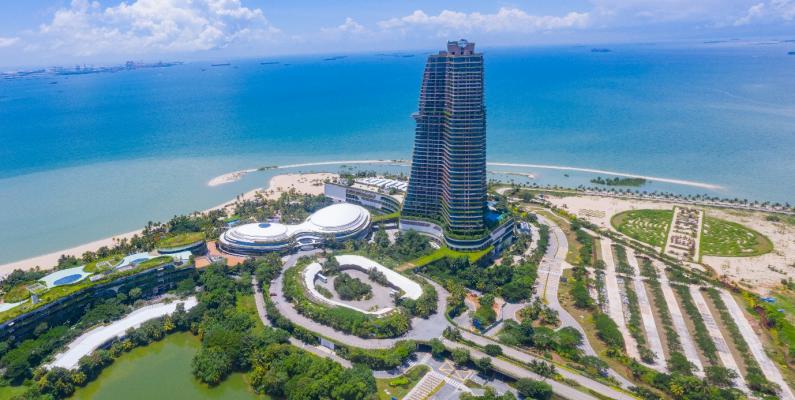
Forest City aerial view — more than 60% of the master plan is dedicated to non-built green space (Source: Forest City SFZ).
While international headlines previously called
Forest City a ghost city,
its buildings earned LEED Gold Pre-Certification, and its development
programme supported the restoration of 9 km of mangroves along the Johor
coastline. Forest City SFZ's updated summary presents a clear,
verifiable record of its environmental performance, including 2.86
million m² of green space, LEED–Core and Shell (CS) Gold
Pre‑Certification, 400+ documented species, 40+ international awards,
and a live coastal restoration programme.
Natazha Harris, CEO of the Johor Investment Promotion Agency (IMFC-J),
noted: "In the first four months of this year, we recorded
48 investment enquiries related to the Forest City SFZ.
The potential investment value under discussion is estimated to reach
several billion ringgit, with the annual target of RM2 billion expected
to be surpassed. Several companies have progressed to advanced
negotiations and feasibility studies, with key sectors including
financial services, the digital economy, green technology, and
high-value-added services. At the same time, areas such as renewable
energy, carbon management, and sustainable urban development continue to
attract strong interest."
ESG Performance in Context: The JS-SEZ Investment Corridor
With the JS-SEZ master plan nearing completion — targeting accelerated
growth across 11 key sectors and aiming to contribute RM 260 billion to
Johor's GDP by 2030 — Forest City SFZ is positioned to improve
cross-border connectivity and attract investors seeking bilaterally
supported
investment opportunities.
As ESG criteria increasingly shape institutional real estate and
infrastructure investment decisions globally, Forest City SFZ offers
corporates and investors a verifiable record to evaluate across four key
pillars: green space, LEED-CS Gold Pre-Certified buildings,
biodiversity, and ongoing restoration efforts. Each pillar provides
measurable environmental data points, while the 2024 Special Financial
Zone designation added a governance dimension: a government-backed
framework now bilaterally endorsed through the Malaysia–Singapore JS-SEZ
agreement signed in
January 2025.
In 2024, Malaysia officially launched the
National Sustainability Reporting Framework (NSRF),
requiring listed companies and large enterprises to adopt IFRS
Sustainability Disclosure Standards. The Singapore Exchange has also
implemented
comparable requirements
for its listed entities, reflecting a growing regional emphasis on
transparency and accountability in sustainability practices. Forest City
continues to advance the adoption of robust sustainability standards
and performance indicators. It serves as a strategic platform that
encourages businesses and investors to prioritise environmental
stewardship while promoting balance between economic development and
natural ecosystem protection. Through a range of structured and
recurring environmental initiatives within the Forest City SFZ,
companies are provided with meaningful opportunities to implement and
demonstrate ESG practices, building tangible track records in
environmental responsibility.
For enterprises operating within the SFZ, this integrated
environment—where land and marine ecosystems are carefully
preserved—enhances their environmental performance and strengthens their
sustainability credentials.
Foundation for ESG Performance: 2.86 Million m² of Total Green Space
Green space serves as a foundational layer of Forest City SFZ's ESG
framework, supporting quantifiable outcomes across building
certification, biodiversity preservation, and coastal restoration
progress.
The master plan dedicates over 60% of the total land area to non-built
space, translating to 2.86 million m² of green infrastructure. This
includes two golf courses, public parks, landscaped residential zones,
and mangrove corridors that extend along the Johor coastline.
As of 2026, this green space supports more than 400 officially
documented species on site. Beyond enhancing its appeal as a
destination, this rich biodiversity serves as tangible evidence of
sustained environmental stewardship. The island's mangroves are critical
contributors to biodiversity, as they support fish nurseries and bird
populations while protecting the coast against erosion.
Land allocation at this scale, defined at the master plan stage,
establishes a more stable foundation for future ESG targets and
initiatives. For investors conducting ESG due diligence, the green-space
ratio represents a structural commitment that cannot be replicated
through incremental upgrades.
Building Credentials: LEED-CS Gold Pre-Certification
Forest City's LEED-CS Gold Pre-Certification, a premier international
sustainability standard for green buildings, provides an externally
validated benchmark for sustainable building design. The standard is
awarded by the
U.S. Green Building Council (USGBC), an independent third party recognised globally.
Pre-Certification represents verified design intent and formal
commitment to sustainable performance criteria. It is evidence that
environmental performance was embedded in project planning, not
retrofitted. The standard covers energy modelling, water efficiency,
materials selection, and indoor environmental quality, among other
categories. The credential offers an independently verified data point
aligned with global sustainability standards.
In addition, Forest City's environmental protection and sustainable
development efforts have also received third-party recognition. In 2022,
Forest City received the
Sustainable City and Human Settlements Award (SCAHSA),
presented by the United Nations Global Forum on Human Settlements
(GFHS), for Global Model of Green and Intelligent Construction. In
addition, Forest City has received other SCAHSA awards, such as the 2020
Global Model of Coastal Ecological Environmental Protection Award and
the 2021 Global Model of Low-Carbon City Planning and Design.
Coastal Restoration: Mangroves, Seagrass, and Marine Life
While third-party certification documents existing ecological value,
coastal restoration demonstrates active investment in expanding
environmental outcomes. Forest City's programme focuses on mangrove
restoration along the Johor coastline, a globally recognised climate
adaptation strategy.
Mangroves can store three to four times more carbon per acre than tropical forests. They also serve as natural barriers against storms, help prevent erosion, and support fish nurseries.
During the development phase, the landscape department implemented
mangrove protection initiatives, including monitoring the mangrove
coastline, collecting seeds, and supporting germination in the nursery.
Now, Forest City regularly collaborates with professional environmental
and research institutions, serving as a platform for advancing
initiatives in climate action and biodiversity conservation.
In a recent collaboration with HOPE 100,
around 250 participants planted more than 1,000 mangrove saplings to
help maintain the stability and health of mangrove ecosystems, providing
tangible evidence of progress as longer-term restoration work advances.
The coastal design extends beyond mangroves to include 4 km of
accessible beachfront coastline for residents and visitors, shallow
coves and mudflats, and 250 hectares of seagrass habitat preservation.
Seagrass meadows function as significant long-term carbon sinks,
reinforcing the programme's climate relevance. In collaboration with
Country Garden Pacificview, Universiti Putra Malaysia (UPM) launched a
long-term monitoring and assisted recovery programme (2015–2025)
focused on the seagrass ecosystem at Merambong Shoal, located near
Forest City and recognised as the largest seagrass habitat in Peninsular
Malaysia.
These restoration efforts are already yielding results. Since the
programme's inception, the number of seagrass species at Meambong Shoal
has increased from 8 to 12, alongside a corresponding expansion in
seagrass coverage. The area now supports diverse marine life, including
dugongs, flounders, sea cucumbers,
seahorses, and various fish species, with more than 100 species recorded. The collaboration between both parties remains ongoing.
The Long-Term Proposition: Nature and Commerce in Harmony
Forest City SFZ's environmental investments are not isolated from its
commercial proposition. The same green infrastructure that supports
biodiversity and coastal restoration efforts also underpins a growing
ecosystem of leisure and tourism amenities, creating revenue streams for
long-term economic growth in the JS-SEZ.
The mangrove corridors, 4 km coastline, and sea fishing programmes are
open to day visitors and weekend travellers, weaving green conservation
into the travel experience and positioning Forest City as an emerging
eco-tourism destination within the JS-SEZ corridor. For details, see
Forest City's
tourism facilities.
Golf represents another convergence of environmental planning and
commercial return, integrating ecology and landscape design. The
Forest City Golf Resort
features two critically acclaimed courses with abundant water features
and landscapes surrounded by vast mangrove forests. The courses attract
regional and international players to Johor annually: the
Jack Nicklaus Legacy Course (par-72, 7,386 yards), which has ranked within the top 50 of the 2024–2025 Asia-Pacific Top 100 Golf Courses list, and the
Liang Guo Kun Classic Course (7,138 yards), which has ranked in the Top 100 Golf Courses in Asia for six consecutive years.
Conclusion
Forest City SFZ's latest ESG credentials indicate measurable sustainability progress, evidenced by LEED–CS Gold Pre-Certification, verified green-space and biodiversity metrics, and an ongoing coastal restoration programme.
For investors and corporates navigating tightening ESG disclosure
requirements, these metrics offer a credible basis for due diligence.
While prior "ghost city" narratives suggested limited prospects, current
verifiable records from the U.S. Green Building Council, 40+
international awards recognising planning and sustainability excellence,
and bilateral government endorsement through the JS-SEZ framework
provide a significantly more informed and current basis for assessment.
The
SFZ incentive structure and MM2H programme
round out the proposition, positioning Forest City SFZ not merely as an
environmental benchmark, but also as a credible long-term destination
for capital and talent alike.








 Sabtu, 13 Juni 2026 | 18:08
 Rabu, 10 Juni 2026 | 21:10
 Sabtu, 13 Juni 2026 | 18:10
 Sabtu, 13 Juni 2026 | 18:07
 Sabtu, 13 Juni 2026 | 18:06