Menu Website

- Home
- MediaOutReach
- Doing Good Index 2026: Asia's US$753 Billion Philanthropic Potential Remains Unrealized

Doing Good Index 2026: Asia's US$753 Billion Philanthropic Potential Remains Unrealized
Selasa, 16 Juni 2026 | 10:28
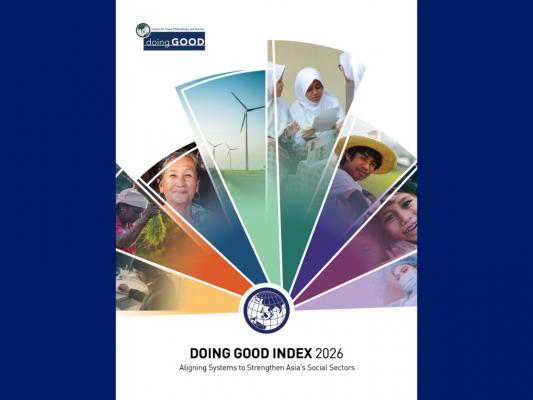
In the 2026 edition of its flagship policy report the Doing
Good Index, the Centre for Asian Philanthropy and Society (CAPS) finds
that Asia's capacity to deploy private capital for social good is not
keeping pace with its potential.
The report finds that while the enabling environment for private social investment is in place across much of the region, its effectiveness remains uneven. Improvements in registration processes and accountability mechanisms have been accompanied by persistent barriers, including restrictions on foreign funding, regulatory complexity, and inconsistent government engagement. In many cases, policies exist on paper but are not fully implemented in practice, limiting their impact.
At the same time, although trust in SDOs remains high across the region, broader ecosystem conditions, such as media sentiment, talent pipelines, and institutional support, are showing signs of strain. 81% of SDOs struggle to secure unrestricted funds for their work, while 73% report difficulty recruiting staff, constraining the sector's ability to turn trust into impact.
"Asia has the wealth, the will, and in many economies, the foundations of a strong enabling environment. What is needed now is concerted, aligned effort to bring them together. The potential is enormous," said Ruth Shapiro, Co-Founder and CEO, Centre for Asian Philanthropy and Society.
If Asian economies were to contribute just 2% of GDP to philanthropy, as the United States does, it could generate an estimated US$753 billion annually for social good. That represents 15 times the official development assistance flowing into the region, and almost half the financing needed to hit the UN's SDGs in Asia. But realizing that potential depends on strengthening the policies, incentives and partnerships that enable private capital to flow toward social good. The Doing Good Index 2026 finds that across much of Asia, those conditions are not yet in place.
"The world has changed dramatically, and Asia can no longer rely on others to address its social challenges. The Doing Good Index 2026 shows the region has the potential to meet this moment, but only if governments and philanthropists act together to build the conditions that make it possible," said Ronnie Chan, Chairman, Centre for Asian Philanthropy and Society.
Singapore Shows What Alignment Can Achieve
Singapore has, for the first time, entered the top "Doing Excellent" category in the Doing Good Index 2026, reflecting years of deliberate effort to build a strong culture of philanthropy and civic engagement. Clear regulations, generous tax incentives, openness to foreign funding, and close collaboration between government and the social sector have created a strong enabling environment.
Singapore's achievement demonstrates that when regulations, fiscal policy, ecosystem conditions and procurement work in concert, the outcomes are stronger. While no two economies will follow the same path, Singapore's experience highlights the conditions that matter, such as the active promotion and alignment of philanthropy and giving across the whole of society.
The SDGs: Falling Short but Still Relevant in Asia
In the run-up to 2030, global progress toward the SDGs has fallen short of ambition, and Asia is no exception. Yet the Doing Good Index 2026 finds that 84% of SDOs continue to apply the SDGs in their work. Further, the rise of Environmental, Social and Governance (ESG) reporting has not displaced them, because most SDOs see the two frameworks as complementary rather than competing.
As the deadline approaches, the Index points to their enduring value not as a target but as a shared framework for strategy, coordination and collective action in the years ahead.
Other Findings from the Report
- - Asia's social sector is under strain: 78% of the 2,166 social delivery organizations (SDOs) surveyed report insufficient domestic funding.
- - Asia is one of the fastest-growing regions for wealth creation, yet the policies and incentives needed to channel it toward social good are not keeping pace.
- - Singapore has become the first economy to enter the "Doing Excellent" category, demonstrating what alignment across regulations, tax incentives, government partnerships and efforts to create a culture of giving can achieve.
- - 84% of Asian SDOs surveyed apply the UN Sustainable Development Goals (SDGs) in their operations, pointing to their enduring value as a shared framework for coordination and collective action beyond 2030.
HONG KONG SAR -
Media OutReach Newswire
- 16 June 2026 - Asia's social needs are intensifying, and official
development assistance is declining. Yet, while the region's wealth is
growing dramatically, the policies, incentives and partnerships needed
to channel private capital toward social good are not keeping pace. That
is a key finding of the Doing Good Index 2026, the fifth edition
of CAPS's flagship policy report, which assesses the enabling
environment for private social investment across 17 Asian economies.
The report finds that while the enabling environment for private social investment is in place across much of the region, its effectiveness remains uneven. Improvements in registration processes and accountability mechanisms have been accompanied by persistent barriers, including restrictions on foreign funding, regulatory complexity, and inconsistent government engagement. In many cases, policies exist on paper but are not fully implemented in practice, limiting their impact.
At the same time, although trust in SDOs remains high across the region, broader ecosystem conditions, such as media sentiment, talent pipelines, and institutional support, are showing signs of strain. 81% of SDOs struggle to secure unrestricted funds for their work, while 73% report difficulty recruiting staff, constraining the sector's ability to turn trust into impact.
"Asia has the wealth, the will, and in many economies, the foundations of a strong enabling environment. What is needed now is concerted, aligned effort to bring them together. The potential is enormous," said Ruth Shapiro, Co-Founder and CEO, Centre for Asian Philanthropy and Society.
Unlocking Asia's US$753 Billion Philanthropic Potential
Even as Asia's wealth continues to grow, the region faces significant
and intensifying challenges across climate, education and health.
Official development assistance is declining, and there is increasing
pressure on domestic resources at precisely the moment demand for social
services is rising.
If Asian economies were to contribute just 2% of GDP to philanthropy, as the United States does, it could generate an estimated US$753 billion annually for social good. That represents 15 times the official development assistance flowing into the region, and almost half the financing needed to hit the UN's SDGs in Asia. But realizing that potential depends on strengthening the policies, incentives and partnerships that enable private capital to flow toward social good. The Doing Good Index 2026 finds that across much of Asia, those conditions are not yet in place.
"The world has changed dramatically, and Asia can no longer rely on others to address its social challenges. The Doing Good Index 2026 shows the region has the potential to meet this moment, but only if governments and philanthropists act together to build the conditions that make it possible," said Ronnie Chan, Chairman, Centre for Asian Philanthropy and Society.
Singapore Shows What Alignment Can Achieve
Singapore has, for the first time, entered the top "Doing Excellent" category in the Doing Good Index 2026, reflecting years of deliberate effort to build a strong culture of philanthropy and civic engagement. Clear regulations, generous tax incentives, openness to foreign funding, and close collaboration between government and the social sector have created a strong enabling environment.
Singapore's achievement demonstrates that when regulations, fiscal policy, ecosystem conditions and procurement work in concert, the outcomes are stronger. While no two economies will follow the same path, Singapore's experience highlights the conditions that matter, such as the active promotion and alignment of philanthropy and giving across the whole of society.
The SDGs: Falling Short but Still Relevant in Asia
In the run-up to 2030, global progress toward the SDGs has fallen short of ambition, and Asia is no exception. Yet the Doing Good Index 2026 finds that 84% of SDOs continue to apply the SDGs in their work. Further, the rise of Environmental, Social and Governance (ESG) reporting has not displaced them, because most SDOs see the two frameworks as complementary rather than competing.
As the deadline approaches, the Index points to their enduring value not as a target but as a shared framework for strategy, coordination and collective action in the years ahead.
Other Findings from the Report
- Talent shortages persist for Asia's social sector: more than 70% of SDOs face difficulty recruiting and retaining staff across Asia.
- AI adoption is happening, but usage remains limited: only 13% of surveyed SDOs report using AI regularly.
- 39% of SDOs say claiming tax benefits is difficult, suggesting administrative barriers may be limiting the impact of existing incentives for giving.
BERITA LAINNYA

Selasa, 16 Juni 2026 | 10:29
Selasa, 16 Juni 2026 | 10:29
Selasa, 16 Juni 2026 | 10:28
Selasa, 16 Juni 2026 | 10:27
Selasa, 16 Juni 2026 | 10:18

Senin, 15 Juni 2026 | 20:27
Senin, 15 Juni 2026 | 20:26
Senin, 15 Juni 2026 | 20:25
Senin, 15 Juni 2026 | 20:24

Senin, 15 Juni 2026 | 20:23

Senin, 15 Juni 2026 | 20:22

BERIKAN KOMENTAR


-
 Selasa, 16 Juni 2026 | 10:57
First Phosphate Menutup Penawaran Private Placement yang Oversubscribed dari Investor Lama dan Investor Baru
-
 Selasa, 16 Juni 2026 | 10:55
V3D Asia dan SIRIM Academy Kembangkan Standar Industri Pertama untuk Teknologi Konstruksi 3D di Malaysia
-
 Selasa, 16 Juni 2026 | 10:53
RZOLV Technologies Paparkan Teknologi Hidrometalurgi Bebas Sianida di Forum “Mining Innovation on the Hill” Ottawa
-
 Selasa, 16 Juni 2026 | 10:53
Garvee Hadirkan Koleksi All-Scenario untuk Keluarga Modern dalam Menyambut Musim Panas
-
-


-
-
 Sabtu, 13 Juni 2026 | 18:08
Shopee Hyper Brand Day: Nikmati Diskon Hingga 70% untuk Penawaran TTRacing dan PRISM+ di Musim Piala Dunia Ini
-
 Rabu, 10 Juni 2026 | 21:10
Wali Kota Dumai Turun Langsung Temui Massa, Aksi Buruh TKBM Berakhir Kondusif
-
 Sabtu, 13 Juni 2026 | 18:07
TVBS Terapkan Penerjemahan Berbasis AI untuk Pidato Utama NVIDIA GTC Taipei
-
 Sabtu, 13 Juni 2026 | 18:10
Anggota 1win VIP Community Ilia Topuria Siap Tampil di Laga Utama Bersejarah UFC Freedom 250
-
 Sabtu, 13 Juni 2026 | 18:06
Kualitas Baru, Masa Depan Bersama – Beijing CBD Mengundang Dunia untuk Menjalin Kerja Sama