Hong Kong's first astronaut participates in Shenzhou-23 manned spaceflight mission
Hong Kong's first astronaut participates in Shenzhou-23 manned spaceflight mission
Selasa, 26 Mei 2026 | 20:24
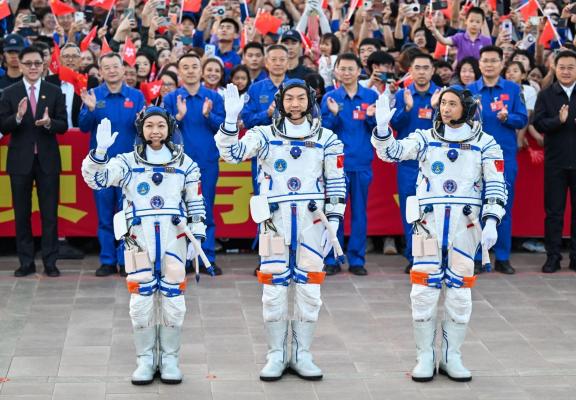
Dr Lai Ka-ying (left) made history by becoming the first Hong Kong astronaut to blast off into space aboard the Shenzhou-23 manned spaceship.
HONG KONG SAR -
Media OutReach Newswire
– 26 May 2026 – At 11.08pm on May 24, Dr Lai Ka-ying made history by
becoming the first Hong Kong astronaut to blast off into space aboard
the Shenzhou-23 manned spaceship. This momentous occasion also launched a
new era for Hong Kong's development of innovation and technology
(I&T) as well as the city's participation in national development
under China's 15th Five-Year Plan.
Congratulating Dr Lai on her achievement, John Lee, Chief Executive of
the Hong Kong Special Administrative Region (HKSAR), said that the HKSAR
can "transform from a 'supporter' of the country's great aerospace
endeavours into an 'executor' ".
"This not only demonstrates the HKSAR's capability in contributing to
the country's development into an aerospace power, but also showcases
how Hong Kong could better integrate into and serve the overall national
development," Mr Lee said.
"This mission is of great significance, as it is not only the first
manned spaceflight mission during the 15th Five-Year Plan period, but
also the first time for a payload expert from the HKSAR to participate
in it."
The Shenzhou-23 crew will conduct on-orbit rotation with the Shenzhou-21
crew. The crew, including Dr Lai, will stay in the space station and
conduct multiple experiments and applications in various fields such as
scientific applications.
The Secretary for Innovation, Technology and Industry of the HKSAR
Government, Professor Sun Dong, led a delegation to the Jiuquan
Satellite Launch Center to witness this historic moment. Members of the
delegation included other government representatives, I&T experts,
youths and students.
"I truly believe this is a great demonstration of Hong Kong integrating
into and serving the overall national development through concrete
actions, while contributing our strength in I&T," Professor Sun
said.
" 'Science and technology is primary productive force, talent is primary
resource, and innovation is primary driver of growth.' The HKSAR
Government will continue to drive the development of I&T, accelerate
the establishment of an international I&T centre, and make greater
contributions to building our nation into a strong power in science,
technology, and aerospace."
Commissioner for Innovation and Technology of the HKSAR Government, Mr
Ivan Lee, said that the Government had been providing funding support
for universities and research institutions in conducting aerospace
technology-related projects through the Innovation and Technology Fund.
"In 2024, we launched a special call for funding applications, inviting
universities to submit project proposals related to aerospace
technology. Following a selection process, we supported six projects.
Among them was the Multi‑Spectral Imaging Carbon Observatory (MUSICO)
developed by a team from the Hong Kong University of Science and
Technology," he said.
On the Tiangong Space Station, Dr Lai will conduct experiments including
operating the MUSICO — the world's first lightweight, high-resolution
synergistic observatory for carbon dioxide and methane emission point
sources.
The Long March 2F Y23 carrier rocket carrying the Shenzhou-23
manned spaceship launched successfully at 11.08pm on May 24 at the
Jiuquan Satellite Launch Center.
Born and raised in Hong Kong, Dr Lai is a Superintendent of the Hong
Kong Police Force. In the recruitment exercise of China's fourth batch
of preparatory astronauts launched in 2022, she was successfully
selected as a payload expert and was deployed to the China Astronaut
Research and Training Center for training.
Before embarking on the historic spaceflight, Dr Lai expressed hope that
it would inspire more Hong Kong youths to devote themselves to the
field of I&T, thereby contributing to the country's scientific and
technological self-reliance and strength.



 https://www.brandhk.gov.hk/
 https://www.linkedin.com/company/brand-hong-kong/
 https://x.com/Brand_HK/
 https://www.facebook.com/brandhk.isd
 https://www.instagram.com/brandhongkong






 Rabu, 20 Mei 2026 | 08:53
 Minggu, 24 Mei 2026 | 10:13
 Minggu, 24 Mei 2026 | 10:17