New Research Finds Application Sprawl Puts APAC Workforces at Credential Risk
New Research Finds Application Sprawl Puts APAC Workforces at Credential Risk
Jumat, 08 Mei 2026 | 10:08
SINGAPORE -
Media OutReach Newswire
- 8 May 2026 - Zoho Corporation released the State of Workforce
Password Security 2026, a global research study covering 3,322 verified
respondents across nine regions, six industries, and twelve roles. The
report, conducted by Tigon Advisory Corp. on behalf of Zoho Vault, finds
a growing disconnect between how organizations perceive credential risk
and how they have acted on it. In APAC, 64% of surveyed businesses run
more than 15 applications, with integrated credential governance
emerging as the region's most critical unmet need.
Timed to coincide with World Password Day, the report arrives at what
the authors describe as a critical inflection point. Across the global
sample, one in three businesses reported a confirmed cyberattack in the
past year, and a further 7% were unable to confirm whether they had been
attacked at all. The APAC region is on par with the global figure on
this metric.
"World Password Day was created to remind people that credentials are
still the entry point to the modern business. What this research shows
is that the entry points have multiplied: the average APAC employee now
logs into more than fifteen business applications, and most
organizations cannot fully account for who has access to what across
them," says Chandramouli Dorai, Chief Evangelist of Cyber Solutions at
Zoho. "The issue is not under-investment, but investment without
architectural coherence, leaving businesses with a significant gap
between intent for security and actual results." APAC is the region with
the second highest application sprawl, with 64% of businesses surveyed
using more than 15 applications, 5 points above the global average.
The State of Security in APAC
There is a consistent theme across APAC respondent data: high awareness,
high spending intent, and persistent visibility gaps. Among APAC
respondents:
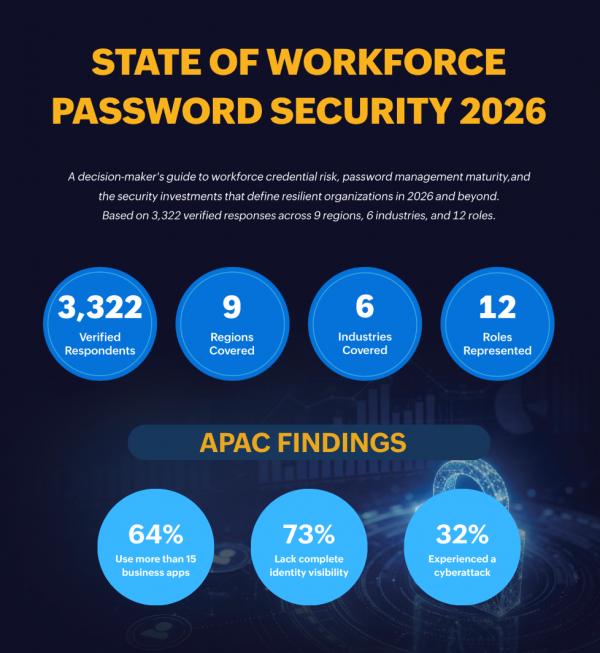
32% experienced a confirmed cyberattack in the past year.
73% lack complete identity visibility across their workforce,
including orphaned accounts and undocumented access, one point lower
than the global average.
74% plan to increase security spending in 2026 — two points above the global average.
64% of employees use 15 or more business applications, five points
above the global average and the second highest application-sprawl rate
of any region globally.
66% have not deployed a Zero Trust strategy, with most non-adopters
expecting to implement within one to three years, this is on par with
global average.
The AI Belief-to-Deployment Gap
The survey also measured business sentiment on AI's role in security
strategy. Confidence is high, with 91% of APAC respondents believing AI
can strengthen their security posture, yet only 8% of businesses
globally are ready to adopt AI-powered security today. This
belief-to-deployment gap is significant. Among desired AI security
features, 68% of respondents prioritized anomaly and threat detection,
compared to 47% who selected risk-based access controls.
The report identifies legacy infrastructure (cited by 52% of global
respondents) and migration complexity (48%) as the primary blockers.
Cost ranks third at 41%, reinforcing a recurring theme across the data:
the constraint on security maturity is not budget but architecture.
"The organizations that will navigate the next five years most
effectively are those investing in architectural simplicity, building
governance models that scale with identity growth, and adopting
AI-enabled orchestration to reduce friction,", says Helen Yu, Founder
and CEO of Tigon Advisory Corp. "Budget is not the primary constraint on
security maturity; architecture, talent, and visibility infrastructure
are. The data in this report is a call to sequence correctly: fix
foundations before chasing advanced capabilities."
The Application Sprawl Problem
The report frames credential risk as a function of attack-surface
growth, and nowhere is that surface expanding faster than in APAC. The
region's mobile-first, multi-cloud work culture means the average
employee now accesses more than 15 business applications daily across
on-site, hybrid, and remote settings. Credential management, in this
context, is not a remote-work problem. It is a structural one.
Yet fewer than one in four organizations globally have deployed a
dedicated password manager. The gap is most acute among SMBs, which
dominate APAC's commercial fabric. More than half of respondents in
organizations under 250 employees report no dedicated security team,
with credential security left to shared spreadsheets, manual hygiene,
and informal policies, what the report calls "the SMB credential blind
spot." In a region where SMB-led growth is central to several national
economies, this represents a systemic and largely unaddressed
vulnerability.
What the Data Recommends
The report concludes with six imperatives for 2026, prioritized by
deployment urgency: deploy a centralized password manager, close the
identity visibility gap, pair password management with multi-factor
authentication, build a Zero Trust roadmap, treat integration as a
security requirement, and pilot AI-powered credential security within
the next twelve months.
"Legacy infrastructure remains the primary blocker between any effective
use of AI, including deploying AI for security," says Mani Vembu, CEO
of Zoho. "Our future-ready stack is built around the premise that
placing identity, access, and applications on the same architectural
foundation provides fewer opportunities for vulnerabilities, higher
identity visibility, and conveniently, an easier method of adding AI to
assist in threat detection. As AI's sophistication in exploiting
security weaknesses rapidly improves, migrating to a secure, AI-ready
platform is only becoming more urgent."
Methodology
The State of Workforce Password Security 2026 was conducted by Tigon
Advisory Corp. and sponsored by Zoho Corporation. The study is based on
3,322 verified responses across nine regions (United States, Canada,
United Kingdom, European Union, India, Middle East and Africa, Australia
and New Zealand, APAC, Japan, and China), six industries, and twelve
workforce roles. Data was collected in early 2026. The full report,
including all regional snapshots and methodology notes, is available at
https://www.zoho.com/vault/state-of-workforce-password-security-report.html.
Zoho Privacy Pledge
Zoho respects user privacy and does not have an ad-revenue model in any
part of its business, including its free products. The company owns and
operates its data centers, ensuring complete oversight of customer data,
privacy, and security. More than 150 million users around the world,
across hundreds of thousands of companies, rely on Zoho every day to run
their businesses, including Zoho itself. For more information,
click here.
About Zoho Vault
Zoho Vault is Zoho's password management application for individuals,
teams, and enterprises, providing centralized credential vaulting,
secure sharing, role-based access, multi-factor authentication, and
integration with Zoho's broader productivity, HR, and IT-management
portfolio. Zoho Vault is included in Zoho One and is also available as a
standalone subscription. More information is available at
zoho.com/vault.
Caption: APAC Findings in New State of Workforce Password Security Report















 Sabtu, 30 Mei 2026 | 10:43
 Sabtu, 30 Mei 2026 | 10:42
 Sabtu, 30 Mei 2026 | 10:41
 Minggu, 24 Mei 2026 | 10:13
 Minggu, 24 Mei 2026 | 10:17
 Minggu, 24 Mei 2026 | 10:10
 Minggu, 24 Mei 2026 | 10:12