Menu Website

- Home
- MediaOutReach
- Survey: AI Investment Boom in Asia Pacific Fuelled More by Fear of Missing Out Than Actual Results

Survey: AI Investment Boom in Asia Pacific Fuelled More by Fear of Missing Out Than Actual Results
Jumat, 12 Juni 2026 | 14:12
SINGAPORE -
Media OutReach Newswire
- 12 June 2026 - Enterprise AI spending is climbing rapidly, with
boards racing to deploy the technology faster than they can measure
whether it works. According to the latest IDC InfoBrief, commissioned by
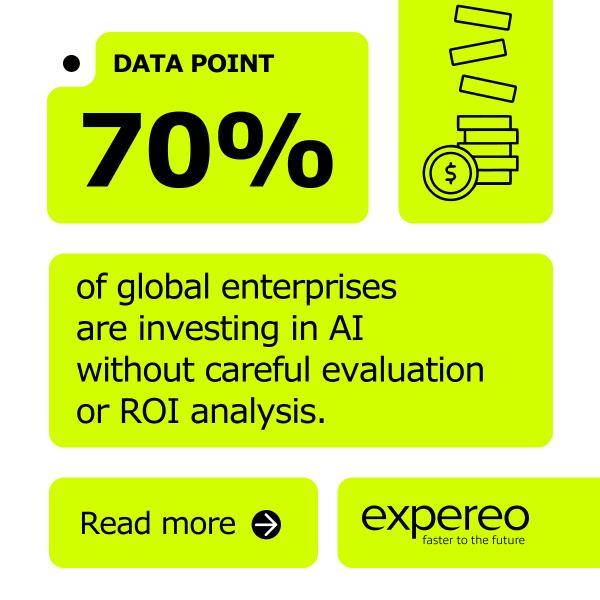
Expereo*, around 70% of organizations are investing in AI, motivated by
its potential or by the fear of falling behind the competition, but
they lag in disciplined ROI evaluation, and one in five (20%) admit they
are investing aggressively in AI with little evaluation, driven by the
fear of being left behind.
In Asia Pacific (APAC), that pressure is even more pronounced as 37% of organizations admit investing aggressively with little evaluation – nearly double the global average, and well ahead of the US (10%) and Europe (13%). The pressure is most acute in Australia (45%) and Vietnam (44%), while in Singapore, more than one in three organizations admit the same.
The IDC InfoBrief, based on a survey of 800 technology leaders across
APAC, Europe, and the US, found that AI has become one of the most
prioritized technology investments globally, with 51% of organizations
planning to prioritize AI or machine learning investment over the next
12 months – rising to 61% across APAC. However, returns are failing to
keep pace with the hype. Just 19% of global organizations surveyed say
their AI implementations have exceeded expectations, and only 5% report
they have significantly exceeded them1.
Across APAC, 40% say implementations have exceeded or significantly
exceeded expectations – ahead of the global average but still leaving
the majority falling short. Globally, the most-cited reasons for
underperformance are inadequate or poor-quality training data (51%),
higher-than-expected costs or ROI not achieved (47%), and AI not
performing as well as expected (46%). For APAC specifically, the picture
is broadly similar – though costs bite harder: 49% cite poor-quality
training data, 54% cite cost overruns or ROI not achieved (rising to 80%
in Malaysia), and 46% say AI has simply not performed as expected.
Where organizations have the right foundations in place, the results
speak for themselves. Across APAC, 87% report productivity improvements
in the business units most affected by AI, and 82% say quality of work
has improved.
Underpinning many of these challenges is also a network and
infrastructure readiness gap. Globally, 26% of organizations whose AI
implementations have failed to meet expectations cite inadequate network
or connectivity performance as a contributing factor. Looking ahead,
54% of organizations say they need more flexible and scalable networks
to thrive in an AI-driven environment, and 51% need greater resilience
and reliability to maximize uptime2. In APAC, the gap is
acute as only 9% of organizations describe their network infrastructure
as fully ready to support new AI, cloud, and digital initiatives, and
37% say it will need upgrading or replacing soon. The need is most acute
in Thailand (74%) and Singapore (58%), both of which rank above the
regional average on demand for flexible, scalable networks. In
Indonesia, nearly half of all organizations (48%) say their
infrastructure will need upgrading or replacing soon.
Ben Elms, CEO, Expereo, says:
"Every enterprise we speak to is investing in AI, yet the data
shows a clear gap opening up between AI ambition and AI outcomes. More
often than not, that gap comes down to the network underneath. AI only
delivers on its promise when the infrastructure carrying it is built to
support it.
Without resilient, scalable, cloud-optimized networks, even the
most well-funded AI programs will struggle to deliver ROI. Getting the
network right is no longer an IT decision; it is one of the most
important conversations happening in the boardroom today to help fulfill
AI ambition."
APAC is also leading on adoption, with 35% of organizations reporting
extensive AI use across the business, against a global average of 25%3. Yet adoption alone is not enough without the right foundations beneath it.
Eric Wong, President, APAC, Expereo, says:
"Asia Pacific is moving aggressively on AI adoption, but
many organizations are discovering that scaling AI successfully requires
more than just investment in applications and models. The underlying
network, cloud connectivity, and operational readiness matter just as
much. Across the region, we are seeing enterprises reassess whether
their infrastructure is truly ready to support AI at scale, particularly
around performance, resilience, governance, and visibility.
Organizations that address those foundations early are generally seeing
stronger outcomes and faster operational impact from their AI
initiatives."
Boardrooms are also waking up to the longer-term risks of unchecked AI
investment. According to the survey, 54% of global tech leaders cite
the creation of new security risks as a significant potential future
threat for their organization's use of AI, while 39% globally are
concerned about losing track of AI-related costs and ROI once the
technology is embedded across the business4. In APAC, that
concern is sharper still as 41% of technology leaders in the region are
worried about losing oversight of AI-related costs and ROI as adoption
deepens – a figure that rises to 54% in Malaysia. Digital sovereignty is
also moving up the strategic agenda, with 38% of APAC organizations
rating it a high or top priority as they look to retain control over
data and navigate an increasingly complex regulatory landscape.
BERITA LAINNYA

Jumat, 12 Juni 2026 | 14:20


Jumat, 12 Juni 2026 | 14:17

Jumat, 12 Juni 2026 | 14:17

Jumat, 12 Juni 2026 | 14:15

Jumat, 12 Juni 2026 | 14:15

Jumat, 12 Juni 2026 | 14:12

Jumat, 12 Juni 2026 | 09:09
Jumat, 12 Juni 2026 | 09:09


BERIKAN KOMENTAR


-

-

-

-

-
 Jumat, 12 Juni 2026 | 14:29
iHerb Luncurkan Promosi 618, Diskon hingga 30% untuk Produk Kebugaran dan Kesehatan Harian
-

-
 Senin, 08 Juni 2026 | 21:46
Muhammad Ramdhani Resmi Dilantik Sebagai Ketua Karang Taruna Kecamatan Dumai Selatan Masa Bakti 2026–2031
-
 Sabtu, 06 Juni 2026 | 10:29
Sun Group debuts at SITF 2026 with exclusive Phu Quoc flight deals and a fresh vision for Vietnam tourism
-
 Sabtu, 06 Juni 2026 | 23:42
Green SM Resmi Luncurkan Green SM Limo di New Delhi, Perluas Layanan Taksi Listrik ke Pasar India
-
 Sabtu, 06 Juni 2026 | 23:44
Belanja Perlengkapan Latihan Andalan Dato' Azizul dengan Pengiriman Super Cepat Shopee
-

-